
Patients judge a hospital before they visit it. Often, that first impression comes from its website.
A Well-Structured Hospital Website builds trust, improves visibility, and guides patients clearly toward appointments or enquiries.
If your website is confusing, slow, or incomplete, patients may leave and choose another provider.
What Is a Well-Structured Hospital Website?

A Well-Structured Hospital Website is a site designed with clarity, accessibility, and patient needs at the center.
It includes:
- Clear navigation
- Dedicated department pages
- Verified doctor profiles
- Easy appointment options
- Fast loading speed
- Secure browsing
Healthcare website structure is not only about design. It is about helping patients quickly find accurate medical information.
Why Website Structure Matters in Healthcare

Healthcare decisions are sensitive. Patients need clarity and reassurance.
In real-world healthcare practices, most patients look for:
- Treatment details
- Doctor qualifications
- Location information
- Contact options
A strong Healthcare website structure reduces confusion and builds confidence before the first hospital visit.
Hospital Website Essential Pages Structure
1- Clear Navigation and Logical Layout
Patients should reach any service within 2–3 clicks.
Best practices for hospital website design include:
- Organized department menus
- Search functionality
- Clear headings (H1, H2, H3)
- Breadcrumb navigation
Poor structure increases bounce rates and reduces patient trust.
2- Dedicated Service and Department Pages
Each specialty should have its own optimized page.
This improves:
- Clarity for patients
- Hospital website SEO performance
- Treatment-based keyword visibility
- Hospital website SEO works best when every major treatment and department has structured, detailed content.
3- Mobile-Friendly Design
More than half of healthcare searches happen on mobile devices.
A Mobile-friendly hospital website ensures:
- Responsive layout
- Fast mobile loading speed
- Easy tap-to-call buttons
- Smooth appointment booking
A Mobile-friendly hospital website is no longer optional. It directly impacts both user experience and search rankings.
4- Strong User Experience (UX)
User experience in healthcare websites determines whether visitors stay or leave.
Important UX factors:
- Simple forms
- Visible emergency contact information
- Clear call-to-action buttons
- Minimal distractions
User experience in healthcare websites must prioritize accessibility and ease of use, especially for elderly patients.
Based on industry experience, complex forms and unclear layouts are common issues hospitals face.
5- Secure and Compliant Website
Healthcare websites must protect patient information.
Important elements:
- HTTPS encryption
- Secure contact forms
- Privacy policy
- Accessibility compliance
A secure Healthcare website structure builds long-term trust and supports regulatory standards.
How Website Structure Impacts SEO
Search engines evaluate:
- Page hierarchy
- Internal linking
- Mobile performance
- Content clarity
A Well-Structured Hospital Website improves crawlability and indexing.
When hospital website design aligns with structured headings and internal linking, search engines better understand the hospital’s services.
Proper Hospital website SEO depends heavily on technical and structural clarity.
Common Mistakes Hospitals Should Avoid

- One-page websites with limited service detail
- No department-specific pages
- Slow loading speed
- Outdated doctor profiles
- No mobile optimization
- Complex navigation
Most clinics face this challenge because they treat websites as brochures instead of digital patient support systems.
How to Evaluate Your Current Website Structure
Ask these questions:
- Can patients find treatment details easily?
- Are doctor credentials visible and verified?
- Is the site fully responsive on mobile?
- Does the site load in under 3 seconds?
- Are pages optimized for Hospital website SEO?
If the answer is no to multiple questions, improvements are needed.
The Role of Website Structure in Digital Marketing
A Well-Structured Hospital Website supports:
- Search engine optimization
- Local visibility
- Content marketing
- Online reputation management
Without strong Healthcare website structure, other marketing efforts lose effectiveness.
1. Why is a hospital website important?
A hospital website serves as a digital front door where patients can explore services, book appointments, and access healthcare information anytime. It builds trust, improves communication, and helps healthcare providers reach more patients online effectively.
2. What features should a hospital website have?
A hospital website should include easy navigation, mobile-friendly design, online appointment booking, doctor profiles, patient testimonials, and secure data handling. These features improve user experience and help patients find information quickly.
3. How does a hospital website attract patients?
A well-optimized website improves search engine visibility, making it easier for patients to find services online. Informative content, strong branding, and easy navigation build trust and encourage users to choose your hospital.
4. How does SEO help hospital websites?
SEO improves your website’s ranking on search engines, helping more patients discover your services. It increases visibility, drives organic traffic, and supports long-term patient acquisition.
5. How can a hospital website build trust?
Trust is built through clear information, doctor credentials, patient testimonials, secure data handling, and high-quality content. These elements help patients feel confident before visiting.
Google Business Profile optimization for doctors helps individual physicians appear in local search and Google Maps results, improve credibility, and attract nearby patients. When combined with professional healthcare SEO services, it plays a critical role in long-term patient acquisition. 77% of patients use a search engine before booking a doctor appointment. And for most of them, the journey ends — or begins — right on your Google Business Profile, without ever visiting your website.
This guide explains how doctors should optimize their Google Business Profile correctly and ethically.
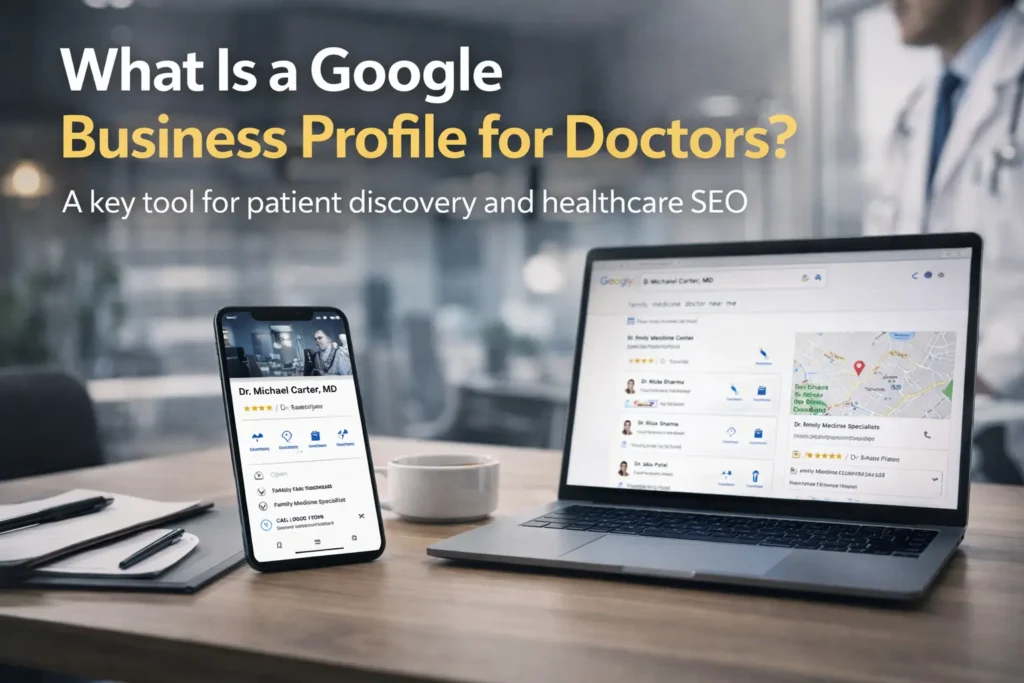
What Is a Google Business Profile for Doctors?
A Google Business Profile (GBP) for doctors is a verified digital listing that represents a doctor’s practice on Google Search and Google Maps. It acts as the primary source of truth for patients looking for nearby medical care and is a foundational element of modern healthcare SEO services.
For doctors, this profile typically includes:
- Doctor or clinic name
- Medical specialty and services
- Practice location and contact details
- Consultation hours
- Patient reviews and ratings
- Photos of the clinic and staff
In practical terms, a Google Business Profile allows patients to evaluate a doctor before making contact. Many patients compare doctors directly within Google results, using profiles to assess credibility, accessibility, and reputation.
In real-world medical practices, GBP often becomes the first and last touchpoint—patients discover the doctor, read reviews, and initiate contact without visiting the website. This behavior is why GBP optimization is emphasized in most healthcare SEO services frameworks.
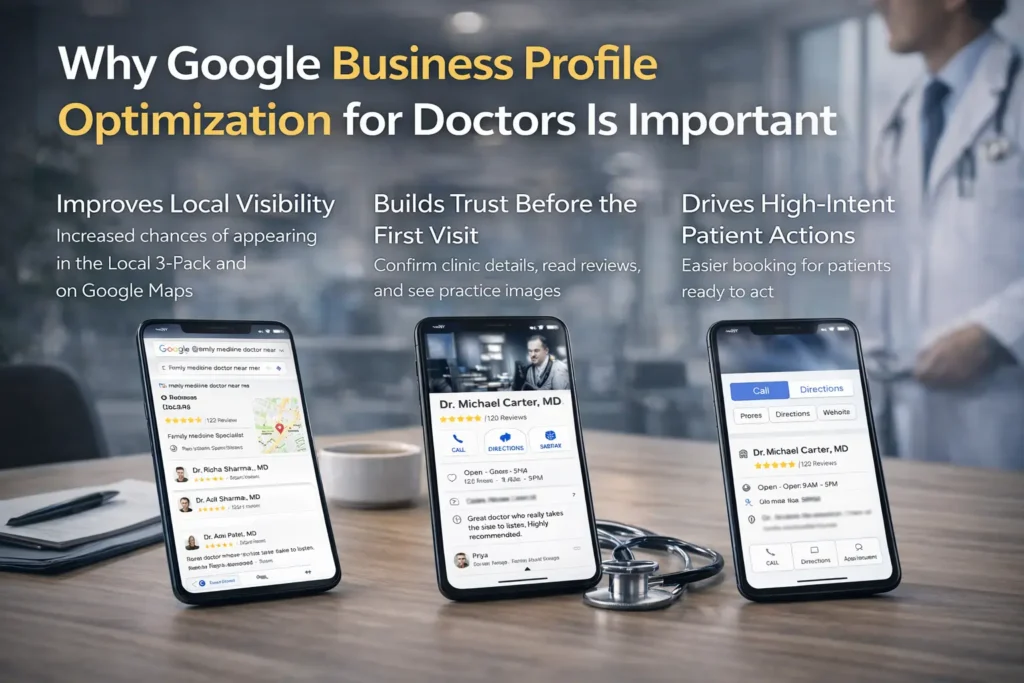
Why Google Business Profile Optimization for Doctors Is Important
Improves Local Visibility
Google uses GBP data to determine:
- Which doctors appear in the Local 3-Pack
- Google Maps rankings
- Nearby physician recommendations
Key numbers every doctor needs to know:
- 77.78% of patients use Google specifically as their primary healthcare review platform, making it the dominant channel above WebMD, Healthgrades, and all others (RepuGen Patient Review Survey, 2025)
- 77% of patients search Google before booking a medical appointment (Optasy / Press Ganey, 2025)
- 84% of patients check online reviews before choosing a new healthcare provider (rater8 How Patients Choose Their Doctors Report, 2025 — 1,008 patient survey)
- 51% of patients read a minimum of 6 reviews before feeling confident enough to book (rater8, 2025)
- 40% of patients have cancelled or avoided booking an appointment because of negative reviews — even when personally recommended (rater8, 2025)
Without optimization, even experienced doctors may not appear in local results. This is a common issue addressed through structured healthcare SEO services provided by Raiseque Healthcare Digital Marketing, which focus on improving local discoverability and patient acquisition.
Builds Trust Before the First Visit
Patients rely heavily on:
- Reviews
- Accurate clinic details
- Visual confirmation of the practice
Most doctors face a common challenge: strong medical expertise but limited online trust signals.
Google Business Profile optimization helps close this gap by creating a professional, transparent, and patient-friendly digital presence.
61% of patients say even a personal recommendation from a friend or family member would not change their mind if they saw negative reviews online.
Drives High-Intent Patient Actions
Users viewing a doctor’s GBP are more likely to:
- Call directly
- Request directions
- Book an appointment
These actions indicate immediate patient intent, not early-stage research.
A well-optimized profile reduces barriers and makes it easier for patients to choose and contact a doctor quickly.
How to Optimize Google Business Profile for Doctors
Optimizing a Google Business Profile is not a one-time task — it is an ongoing process that combines accuracy, content, and patient engagement. Each of the following steps directly influences how Google ranks your profile and how patients perceive your practice.
Optimizing a Google Business Profile requires accuracy, consistency, and ongoing attention. Each step contributes to both visibility and trust.
Claim and Verify the Profile
Doctors must:
- Claim ownership of their Google Business Profile
- Complete Google’s verification process
Verification confirms that the doctor or clinic is legitimate and prevents unauthorized edits. Without verification, profile updates may be limited, and trust signals remain weak.
In practice, verified profiles are often treated as more reliable sources of information by Google—forming an essential baseline for building online credibility.
Choose the Correct Medical Category
Primary category selection is critical because it tells Google what type of doctor you are.
Examples include:
- Doctor
- Physician
- Specialist Clinic (e.g., Neurologist, Gastroenterologist)
Secondary categories should only be added if they accurately reflect the services provided.
Incorrect or misleading category selection is one of the most common local SEO mistakes doctors make and is frequently corrected during healthcare SEO services audits.
Maintain Accurate NAP Details
NAP stands for:
- Name
- Address
- Phone number
These details must be consistent across:
- The clinic website
- Medical and healthcare directories
- Social media profiles
Based on industry experience, inconsistent NAP information reduces Google’s confidence in a doctor’s listing and can confuse patients trying to make contact. Maintaining NAP consistency is a core responsibility of healthcare SEO services.
Even small mismatches—such as a different phone number or spelling—can negatively affect local rankings.
Write a Clear, Patient-Friendly Description
A strong doctor profile description should:
- Clearly explain medical services offered
- Mention specialization or focus areas
- Use simple, patient-friendly language
Avoid:
- Keyword stuffing
- Promotional or exaggerated claims
- Complex medical jargon
Patients are not looking for marketing copy. They want clarity, reassurance, and an understanding of whether the doctor meets their needs.
Upload Real Clinic and Practice Photos
Recommended images include:
- Clinic exterior (helps patients locate the practice)
- Consultation room
- Waiting area
- Doctor and staff (professional, real photos)
Authentic images help patients visualize the clinic environment and reduce uncertainty. Profiles with real photos typically receive higher engagement and trust compared to those using stock images or having no images at all.
Doctors who add photos to their Google Business Profile see 45% more direction requests and 31% more website clicks than those without photos. Profiles with 100 or more images receive 2,717% more direction requests than those with a single image.
Manage and Respond to Patient Reviews
Reviews are a major factor in both local rankings and patient decision-making.
Reviews are no longer optional. According to rater8’s 2025 survey of 1,008 U.S. patients:
- 84% check online reviews before choosing a new doctor
- 51% read at least 6 reviews before deciding
- 40% cancelled a planned appointment because of negative reviews
- Nearly half (45%) value doctors who actively respond to reviews, positive or negative
Despite this, 57% of patients rarely or never leave a review — meaning the practices that actively ask for feedback have a massive advantage over those that don’t.
Best practices include:
- Encouraging honest, voluntary patient feedback
- Responding professionally to all reviews
- Never disclosing patient or treatment details
Google favors profiles that demonstrate active, ethical, and responsible review management, especially in healthcare.
Post Regular Updates
Businesses that post weekly on their Google Business Profile see a 26% increase in local impressions — and profiles that include photos in posts get significantly more engagement than text-only updates.
Doctors can use Google Business Profile posts for:
- Clinic announcements
- Holiday or schedule changes
- Health awareness messages
Regular updates signal that the practice is active and engaged. From Google’s perspective, this improves relevance. From a patient’s perspective, it shows attentiveness and professionalism—both reinforced through healthcare SEO services.
GBP Audit for Doctors — Free 30-Minute Consultation
Tools Doctors Can Use to Manage and Monitor Their Google Business Profile
Most doctors set up their Google Business Profile once and forget it. The practices that consistently outrank competitors are the ones actively monitoring performance and tracking what competitors are doing. These free and low-cost tools make that possible without needing a full marketing team.
1. GMB Everywhere (Free Chrome Extension) GMB Everywhere is a Chrome extension that overlays Google Business Profile data directly onto Google Maps search results. When you search for “cardiologist in Mumbai” or “dermatologist near me,” it shows you the exact categories, review counts, and profile completeness of every competitor appearing in the Local 3-Pack — right on the search results page.
For doctors, this means you can instantly see which primary category your highest-ranking competitor is using, how many reviews they have, and what secondary categories they have selected.
Install it free at: gmbeverywhere.com
2. Google Search Console (Free — by Google) Google Search Console shows you exactly which search queries are driving patients to your profile and website, how many impressions and clicks your listing gets, and which pages Google is indexing. For a doctor’s GBP strategy, it is the single most important free monitoring tool available.
Connect your website and GBP together inside Search Console to get a unified picture of how your local presence is performing in Google’s eyes.
Access it free at: search.google.com/search-console
3. BrightLocal (Paid — from $39/month) BrightLocal is the industry standard for tracking local search rankings by city, neighbourhood, or postal code. For doctors with clinics in specific areas, it lets you see exactly where you rank in Google Maps for searches like “orthopaedic surgeon in [area]” — including a visual grid map showing your ranking at different geographic points around your clinic.
It also audits your NAP consistency across directories and tracks your review growth over time across Google, Healthgrades, and Practo.
Explore it at: brightlocal.com
4. Whitespark Local Citation Finder (Free + Paid plans) Citations — mentions of your clinic’s Name, Address, and Phone number on other websites — directly influence your Google Maps prominence score. Whitespark scans the web and finds every directory, healthcare listing, and local site where your clinic should be listed but isn’t.
For doctors, it specifically identifies healthcare directories like Practo, Justdial, Lybrate, and hospital directories where an accurate listing would boost local ranking signals.
Explore it at: whitespark.ca
5. GS Location Changer (Free Chrome Extension) GS Location Changer lets you change your virtual search location inside Google Maps, so you can see exactly what your Google Business Profile looks like to a patient searching from a different part of your city or from a nearby city altogether.
This is particularly useful for doctors who want to check their visibility in a specific neighbourhood without physically being there.
Install it free at: Chrome Web Store — GS Location Changer
Common Google Business Profile Mistakes Doctors Should Avoid
Many doctors unintentionally harm their local visibility by making avoidable Google Business Profile mistakes.
Common issues include:
- Adding keywords to the doctor or clinic name to manipulate rankings
- Creating multiple or duplicate listings for the same practice
- Using incorrect or outdated clinic addresses
- Ignoring patient reviews, especially negative ones
- Setting incorrect consultation hours
These mistakes confuse both Google and patients. From Google’s perspective, inconsistent or misleading information reduces trust. From a patient’s perspective, it creates doubt about professionalism and reliability.
Based on industry experience, even small errors—such as a mismatched phone number or incorrect map pin—can significantly impact Google Maps rankings for doctors.
Avoiding these mistakes is often the first step toward improving local performance.
How Google Ranks Doctor Profiles Locally
Google ranks doctor profiles locally using three primary factors:
Relevance
How well a doctor’s profile matches the patient’s search query.
This includes:
- Correct medical categories
- Clear service descriptions
- Accurate specialization information
Distance
How close the doctor’s practice is to the patient’s location at the time of the search.
Distance cannot be controlled, but accurate address and map placement are essential.
Prominence
According to BirdEye’s State of Google Business Profile 2025 report, even a single additional review can generate 600+ additional search impressions, 80+ more website visits, 63+ more direction requests, and 16+ more calls per month. In competitive medical markets, review velocity — how consistently new reviews arrive — is often the deciding factor between appearing in the Local 3-Pack or being buried below it.
How well-known and trusted the doctor appears online.
This is influenced by:
- Number and quality of patient reviews
- Review responses
- Profile activity and completeness
In competitive medical markets, prominence often becomes the deciding factor between doctors appearing in top search results or being pushed down the list. Consistent optimization efforts help improve prominence over time.
Well-maintained profiles that consistently reflect real-world practice tend to perform better over time.
Learn More About Local SEO for Healthcare
Google Business Profile optimization for doctors is a key part of a broader local search strategy, but it does not work in isolation. While an optimized GBP helps doctors appear in Google Maps and “near me” searches, sustainable local visibility depends on multiple factors working together.
These include on-page website optimization, consistent local citations, patient reviews, accurate business information, and overall website trust signals. When these elements align, doctors are more likely to appear consistently across local search results and Maps.
To understand how all these components work together—and how medical practices can build long-term local visibility—read our complete guide on [Local SEO for Healthcare].
Continue Learning: Local SEO for Doctors and Clinics
Google Business Profile optimization is one piece of a larger local search strategy. These guides cover the next steps every doctor and clinic should take to build long-term visibility on Google.
Article 1: What Is Local SEO for Healthcare? Why It Matters for Clinics and Hospitals

Your Google Business Profile works best when it is backed by a complete local SEO strategy. This guide explains hat local SEO means specifically for healthcare providers, why it is the foundation of long-term patient acquisition, and how clinics and hospitals can build visibility that does not depend on paid advertising.

Read the Full Guide →

Article 2: How Google Maps Ranking for Clinics and Hospitals Works

Appearing in Google Maps is not random — it follows a specific ranking algorithm based on relevance, distance, and prominence. This guide breaks down exactly how Google decides which clinics appear in the Local 3-Pack and what doctors can do to improve their position in Maps results for high-intent patient searches.

Read the Full Guide →
Article 3: Local SEO Guide for Clinics and Doctors

A complete step-by-step local SEO guide written specifically for medical practices. Covers everything from optimising your Google Business Profile and building local citations to collecting patient reviews and creating location-specific content that attracts nearby patients searching for your specialty.

Read the Full Guide →

Article 4: Why New Clinics Fail in the First Year — And What Most Doctors Get Wrong

Most new clinics lose patients not because of poor medical care but because of invisible online presence. This guide identifies the most common digital mistakes doctors make in the first year of practice — including weak GBP setup, no review strategy, and inconsistent local information — and shows exactly how to fix them before they cost you patients.

Read the Full Guide →
FAQ Section
Q1. What is Google Business Profile optimization for doctors?
Google Business Profile optimization for doctors is the process of completing, updating, and actively managing a doctor’s Google listing so it ranks higher in local search results and Google Maps. This includes selecting the correct medical categories, writing a keyword-rich practice description, uploading real clinic photos, collecting patient reviews, and posting regular updates. When done correctly, an optimized profile helps doctors appear in the Local 3-Pack — the top three results that appear before any website listings — where most patients make their final decision on which doctor to contact.
Q2. Can individual doctors have their own Google Business Profile?
Yes, individual doctors can and should have their own Google Business Profile, provided they see patients at a physical location and are the primary practitioner at that address. A solo physician, specialist, or independent consultant qualifies for a verified GBP listing tied to their clinic address. If a doctor practices at multiple locations, a separate verified profile should be created for each physical address, as Google’s local ranking algorithm is tied to physical proximity to the patient searching.
Q3. How often should doctors update their Google Business Profile?
Doctors should update their Google Business Profile at least once or twice per month to maintain strong local search visibility. Regular updates can include new clinic photos, Google Posts about health awareness topics or appointment availability, changes to consultation hours, or responses to recent patient reviews. Google’s local ranking algorithm treats consistent profile activity as a signal that the practice is active and trustworthy — inactive profiles gradually lose ground to competitors who update regularly, even if the inactive profile was better optimized initially.
Q4. Do Google reviews affect doctor rankings?
Yes, Google reviews are one of the strongest local ranking signals for doctors and directly influence where a profile appears in Google Maps and the Local 3-Pack. According to rater8’s 2025 patient survey, 84% of patients check online reviews before choosing a new healthcare provider, and 51% read at least six reviews before booking. Beyond rankings, reviews affect conversion — 40% of patients have cancelled a planned appointment due to negative reviews, meaning that managing and responding to reviews is not just an SEO task but a direct patient acquisition responsibility.
Q5. Is Google Business Profile free for doctors?
Yes, Google Business Profile is completely free for doctors to claim, set up, and manage. There is no subscription fee or paid tier required to appear in Google Maps or the Local 3-Pack — a fully optimized free profile can outrank paid advertisements in local search results. The only investment required is time spent on optimization: selecting accurate medical categories, writing a strong practice description, uploading photos, collecting patient reviews, and posting regular updates. Doctors who invest this time consistently see measurable improvements in patient enquiries directly from their profile.
Q6. How long does Google Business Profile optimization take to show results for doctors?
Most doctors begin seeing improvements in local search visibility within 4 to 8 weeks of completing a full Google Business Profile optimization — though competitive markets or recently created profiles may take 3 to 6 months to build enough prominence to rank consistently in the Local 3-Pack. The fastest gains typically come from fixing profile completeness issues, correcting NAP inconsistencies, and beginning an active review collection strategy. Long-term ranking stability depends on ongoing activity including monthly posts, photo updates, and consistent review responses rather than a single one-time optimization effort.
Q7. What is the best primary category for a doctor on Google Business Profile?
The best primary category depends on the doctor’s specialty. General practitioners should select “Doctor” or “Physician,” while specialists should use their exact specialty category such as “Cardiologist,” “Dermatologist,” “Orthopedic Surgeon,” or “Pediatrician.” Using the most specific category available is critical because it tells Google’s algorithm exactly what type of medical care the practice provides, improving relevance for specialty-specific searches like “skin doctor near me” or “heart specialist in [city].” Secondary categories can be added for any additional services offered, but the primary category should always reflect the doctor’s core specialty.
80%+ patients search online before choosing a hospital—if you’re not ranking, you’re invisible. SEO for hospitals improves online visibility, builds credibility, and connects hospitals with patients actively searching for treatment.
This guide explains how a structured healthcare SEO strategy helps hospitals rank higher and attract genuine patient inquiries.
This guide explains how a structured healthcare SEO strategy helps hospitals rank higher and attract genuine patient inquiries.
For expert implementation, partnering with a professional healthcare marketing team like Raiseque Healthcare Digital Marketing ensures your hospital achieves consistent growth and higher search visibility.
Hospital SEO is the process of optimizing a hospital’s website and online presence to rank higher on Google for patient-related searches like “hospital near me” or “best orthopedic doctor.” Understanding how do SEO services help hospitals is important because effective SEO improves online visibility, increases patient trust, and helps hospitals attract more local patient inquiries organically.
It includes local SEO, content optimization, Google Business Profile management, and patient review strategies.
What Is SEO for Hospitals?
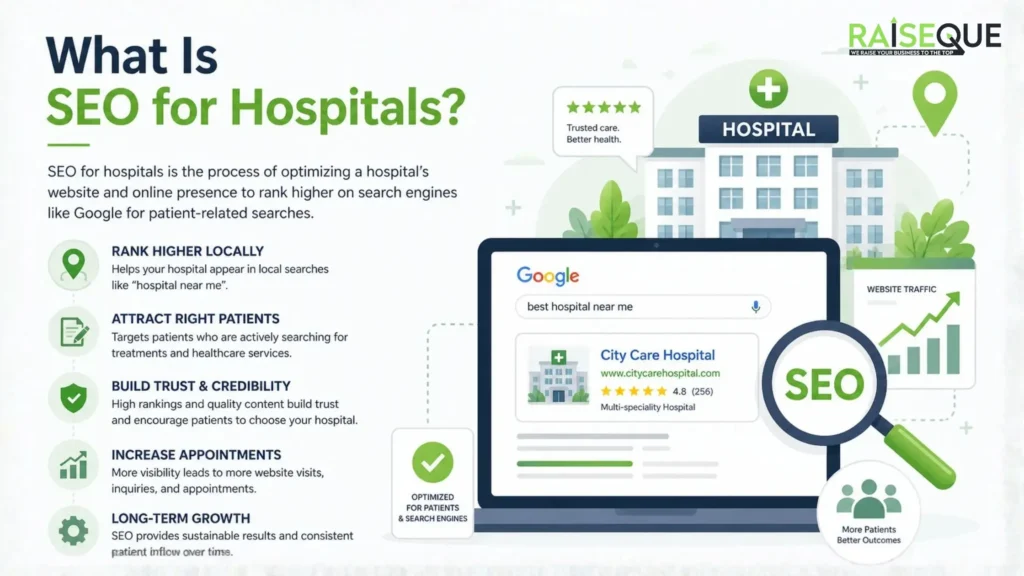
SEO for hospitals is a specialized digital marketing strategy that optimizes a healthcare facility’s website and online presence to rank higher in search results (like Google). It focuses on increasing visibility for patient queries—such as “best pediatrician near me”—to drive organic traffic, build trust, and boost appointment bookings.
Local SEO
Local SEO helps hospitals appear in location-based searches when patients look for nearby healthcare services. By optimizing Google Business Profile, maintaining consistent Name, Address, and Phone details, and using location-specific keywords, hospitals can improve their visibility in local results and maps. This ensures that patients in the surrounding area can easily find and contact the hospital when they need immediate or planned medical care.
Content Marketing
Content marketing focuses on creating valuable, patient-focused information that answers common healthcare questions. Hospitals can publish blogs, treatment guides, FAQs, and preventive care tips to educate patients and build trust. High-quality content improves search rankings and keeps users engaged. When content aligns with patient intent, it not only attracts traffic but also supports better decision-making and encourages patients to choose the hospital.
Technical SEO
Technical SEO ensures that a hospital website performs efficiently and provides a smooth user experience. This includes improving website speed, ensuring mobile responsiveness, fixing crawl errors, and maintaining a clean site structure. Proper technical optimization helps search engines understand and index the website effectively. A technically strong website not only ranks better but also keeps users engaged and reduces bounce rates.
E-E-A-T (Experience, Expertise, Authoritativeness, and Trustworthiness)
E-E-A-T is a critical factor in healthcare SEO, as patients rely on accurate and trustworthy information. Hospitals must demonstrate expertise by showcasing qualified doctors, verified medical content, and real patient experiences. Authoritativeness comes from strong online presence and mentions, while trustworthiness is built through transparency and credibility. Following E-E-A-T principles helps improve rankings and ensures patients feel confident in the hospital’s services.
Hospital SEO vs Clinic SEO: Key Differences
Many hospitals make the mistake of applying a clinic-level SEO strategy to a much more complex organisation. Understanding the differences is essential before building your strategy.
| Factor | Hospital SEO | Clinic SEO |
|---|---|---|
| Scope | Multiple departments, specialties, locations | Single specialty or service line |
| Pages needed | 100+ (each department, doctor, service) | 10–30 pages typically sufficient |
| Keyword strategy | Multi-specialty + local + emergency keywords | Single-specialty local keywords |
| Content complexity | Very high — requires medical accuracy across all departments | Moderate — focused on one area |
| Google Business Profile | Multiple GBP listings (one per location/department possible) | Single GBP listing |
| HIPAA complexity | High — multiple touchpoints and data systems | Moderate |
| Review management | Across multiple platforms and departments | Primarily Google and Practo/Healthgrades |
| Schema types needed | Hospital, Physician, MedicalClinic, FAQPage, LocalBusiness | MedicalClinic, Physician, LocalBusiness |
✅ Quick win: If you are using WordPress, plugins like RankMath or Yoast SEO Premium can generate most of this schema automatically. However, always verify implementation using Google’s Rich Results Test tool.
Why SEO Is Important for Hospitals ?
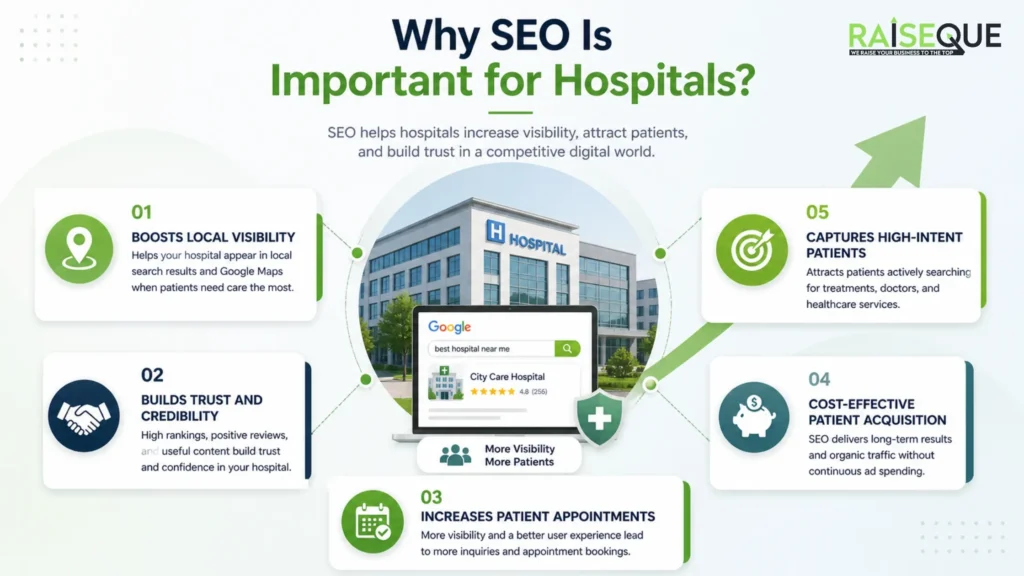
SEO is crucial for hospitals to increase visibility, attract patients, and build trust in a competitive, local digital market. As 77% of patients search online before booking, high search rankings drive patient acquisition, and Local SEO ensures clinics appear in relevant “near me” searches.
To achieve consistent results, hospitals must focus on the following core SEO components:
1. Boosts Local Visibility
SEO helps hospitals appear in local search results when patients look for nearby treatments or services. By optimizing location-based keywords, Google Business Profile, and consistent contact details, hospitals can rank higher in map listings and “near me” searches. This increases visibility among nearby patients actively seeking care. Professional Hospital SEO Services ensure accurate local optimization, helping hospitals attract more relevant traffic and improve their presence in competitive local markets.
2. Builds Trust and Credibility
Patients trust hospitals that appear at the top of search results with accurate and reliable information. SEO strengthens credibility by highlighting doctor expertise, certifications, and verified medical content. Positive patient reviews and informative blogs further build confidence. When hospitals consistently provide trustworthy content and maintain a strong online presence, patients feel more comfortable choosing their services.
3. Increases Patient Appointments
A well-optimized website guides patients smoothly from search to booking. SEO ensures that service pages, doctor profiles, and contact options are easy to find and use. Clear calls-to-action and mobile-friendly design encourage users to take action. This results in more appointment bookings and a steady flow of patient inquiries through the website.
4. Cost-Effective Patient Acquisition
SEO delivers long-term results without requiring continuous ad spending. Once a hospital achieves strong rankings, it can attract consistent organic traffic without paying for each click. This makes SEO a cost-effective strategy for acquiring new patients. Over time, it helps reduce marketing costs while maintaining steady growth in patient inquiries and online visibility.
5. Captures High-Intent Patients
SEO targets users who are actively searching for specific treatments, doctors, or healthcare services. These users have clear intent and are more likely to convert into patients. By optimizing content for relevant keywords and search queries, hospitals can attract highly qualified traffic that leads to better engagement, higher conversion rates, and improved patient acquisition outcomes.
6. Strengthens Competitive Advantage
Hospitals in competitive locations need strong online visibility to stand out. SEO improves rankings, enhances content quality, and delivers a better user experience. This helps hospitals outperform competitors and attract more patients. experience, consistent optimization produces sustainable growth compared to short-term advertising.
How to Do SEO for Hospitals
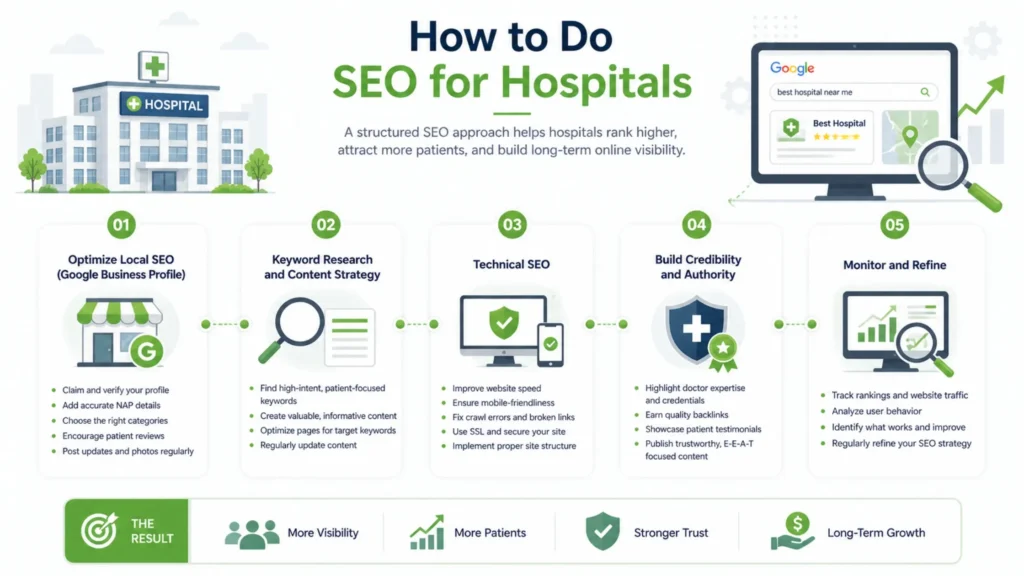
SEO for hospitals requires a strong focus on local visibility, patient trust, and technical accuracy. Key strategies include optimizing Google Business Profiles, targeting local keywords (e.g., “orthopedist near me”), creating authoritative, expert-verified health content, ensuring mobile responsiveness, managing patient reviews, and implementing schema markup.
The following strategies will help hospitals improve search visibility, build credibility, and consistently attract qualified patients.
1. Optimize Local SEO (Google Business Profile)
Local search visibility is essential for patient acquisition. Start by claiming and verifying your Google Business Profile to appear in Google Maps and local results. Ensure your Name, Address, and Phone number (NAP) remain consistent across all platforms. Add accurate operating hours, services, and high-quality images.
Select the most relevant categories such as “Multispecialty Hospital” and include attributes like “24/7 emergency.” Encourage patients to leave reviews and respond professionally to build trust. This directly strengthens local SEO for clinics and improves local rankings.
2. Keyword Research and Content Strategy
You should focus on patient-centric keywords based on real search behavior. Use terms like “hip replacement,” “MRI scan,” and location-based queries. This approach improves visibility and supports SEO for doctors by helping individual practitioners rank.
Create dedicated service pages for each treatment, highlighting advanced technology and experienced doctors. Build authority by publishing educational blogs that address patient concerns. Ensure medical professionals review content to meet E-E-A-T standards. Adding video content such as doctor introductions and patient testimonials enhances engagement and supports modern healthcare marketing strategies.
3. Technical SEO
A strong technical foundation ensures better rankings and user experience. Use a mobile-first design so your website works smoothly on all devices. Improve site speed, fix crawl errors, and maintain a clean navigation structure.
Implement schema markup to help search engines understand your hospital’s services, location, and appointment options.
4. Build Credibility and Authority
List your hospital consistently across trusted healthcare directories. Earn backlinks from reputable local and medical websites to improve domain authority and trust signals.
5. Monitor and Refine
Track performance using tools like Google Analytics and Search Console. Monitor keyword rankings, traffic, and user behavior. Analyze competitor strategies to refine your SEO approach continuously.
Hospitals can also combine organic efforts with Google Ads for hospitals to maximize visibility and attract patients at every stage of their search journey.
HIPAA-Compliant SEO Practices for Hospitals
HIPAA Compliance (Health Insurance Portability and Accountability Act) is not just a legal requirement in the US — it is an increasing standard globally, and it directly intersects with hospital SEO in ways that many marketing teams overlook.
Where HIPAA Compliance Affects SEO
- Review responses: Never confirm, deny, or include any patient-identifying detail in a public review response. A response that says “We’re glad your knee surgery went well, Mr. Sharma” is a HIPAA violation.
- Contact forms: Patient inquiry forms must use HTTPS and compliant data handling. An unsecured form on an HTTP page will also hurt your SEO.
- Analytics tracking: Standard Google Analytics 4 may collect PHI (Protected Health Information) through URL parameters (e.g. booking confirmation pages). Use GA4 with IP anonymisation and avoid tracking sensitive URL strings.
- Retargeting pixels: Meta Pixel and Google Ads remarketing tags should not fire on pages where health conditions or treatment intent can be inferred.
- Testimonials: Patient testimonials on your website require explicit written consent. Unconsented testimonials can result in regulatory action — and authentic, consented testimonials are stronger E-E-A-T signals anyway.
Hospital Website SEO Strategy
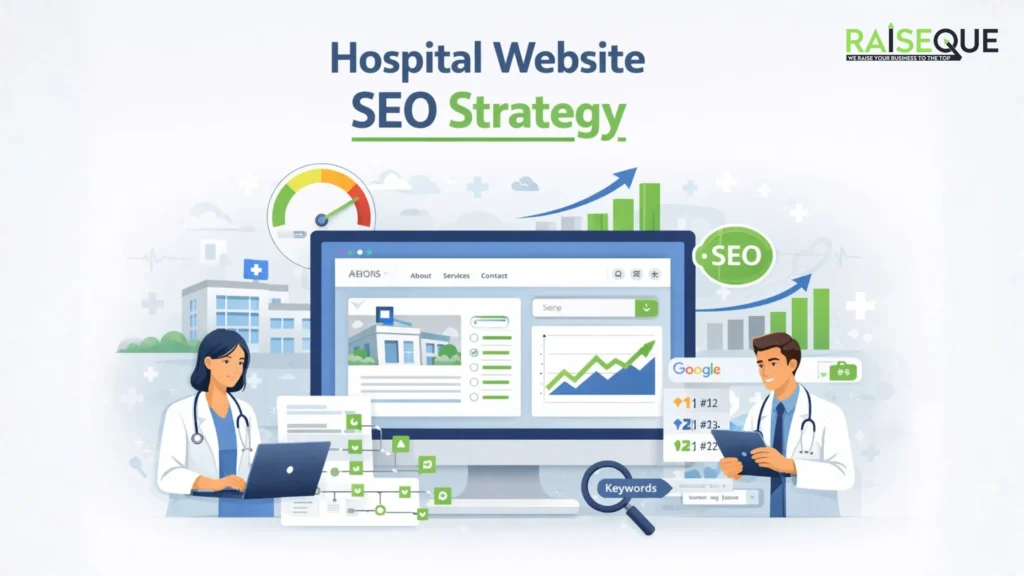
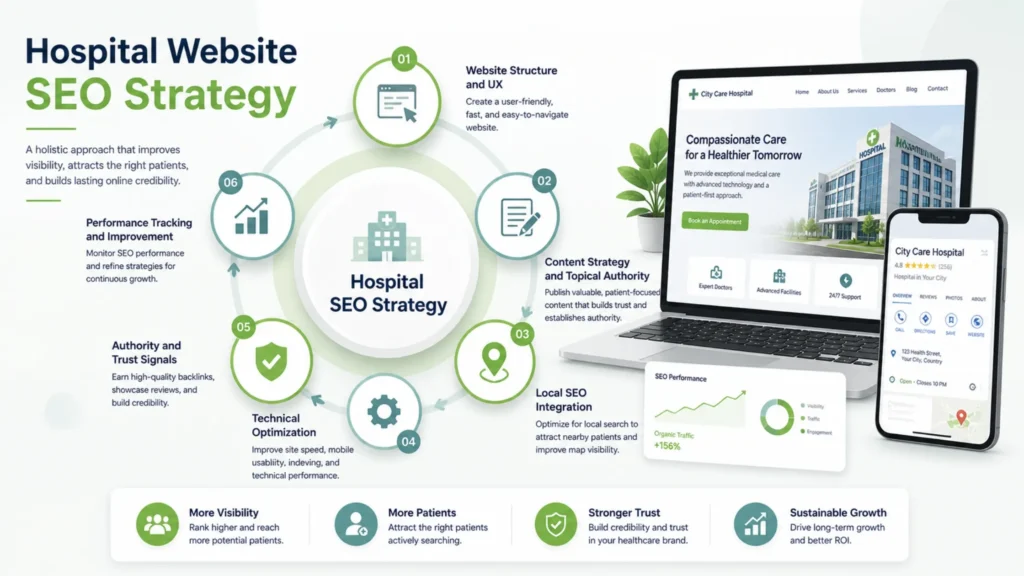
A successful hospital SEO strategy focuses on local search visibility, technical performance, and patient-focused content, while ensuring HIPAA compliance. Effective hospital SEO includes optimizing Google Business Profiles, using long-tail keywords (e.g., “knee surgery in Pune”), improving mobile load speed, and building trust through patient reviews and credible healthcare content.
The following key strategies help hospitals build a high-performing, search-optimized website:
1. Website Structure and User Experience
Hospitals should organize their website into clear sections such as services, doctor profiles, departments, and contact pages. A clean structure helps users navigate easily and allows search engines to understand content better. Use internal linking to connect related pages and improve engagement.
2. Content Strategy and Topical Authority
Content should focus on patient needs and search intent. Create topic clusters around treatments, conditions, and preventive care. Each service page should provide detailed, easy-to-understand information. Regular blog updates help build authority and align with effective healthcare marketing strategies.
3. Local SEO Integration
Hospitals must optimize their website for local searches by including location-based keywords naturally within content. Add consistent NAP details and embed maps to strengthen local SEO for clinics and improve local rankings.
4. Technical Optimization
Ensure the website is mobile-friendly, fast-loading, and secure. Fix broken links, improve site speed, and maintain a clear URL structure. Implement schema markup to enhance search engine understanding.
5. Authority and Trust Signals
Showcase doctor credentials, certifications, and patient testimonials to build trust. This improves credibility and supports both hospital branding and SEO for doctors.
6. Performance Tracking and Improvement
Monitor website performance using analytics tools. Track keyword rankings, user behavior, and conversions. Continuously refine your strategy based on data insights.
How Hospitals Rank on Google
Hospitals rank on Google by prioritizing local SEO, mainly through a fully optimized Google Business Profile (GBP), high-quality patient reviews, and mobile-friendly, authoritative website content. Key strategies include maintaining consistent NAP (Name, Address, Phone) data, using local keywords, and building backlinks, typically yielding results in 3-6 months.
The following factors play a key role in how hospitals rank on Google:
1. Content Relevance and Quality
Google evaluates how well your content matches patient search intent. Hospitals should create detailed, accurate, and easy-to-understand content for treatments, conditions, and services. Regularly updating blogs and service pages improves relevance and supports effective healthcare marketing strategies.
2. E-E-A-T and Trust Signals
Experience, Expertise, Authoritativeness, and Trustworthiness are critical ranking factors in healthcare. Hospitals that understand how to improve hospital search engine rankings SEO for hospitals should highlight doctor credentials, certifications, and verified medical content. This also improves visibility for individual practitioners through SEO for doctors.
3. Local Ranking Factors
Google uses proximity, relevance, and prominence to rank hospitals in local searches. Optimizing Google Business Profile, maintaining consistent NAP details, and collecting patient reviews significantly improve local SEO for clinics.
4. Technical SEO and User Experience
A fast, mobile-friendly, and secure website improves user engagement and rankings. Clear navigation, proper site structure, and schema markup help search engines understand your content better.
5. Backlinks and Online Authority
Google considers backlinks as a signal of trust. Hospitals should earn links from reputable healthcare websites, directories, and local organizations to build authority.
6. User Engagement Signals
Metrics like click-through rate, time on page, and bounce rate indicate content quality. A well-optimized website keeps users engaged and improves rankings over time.
Common SEO Mistakes Hospitals Should Avoid
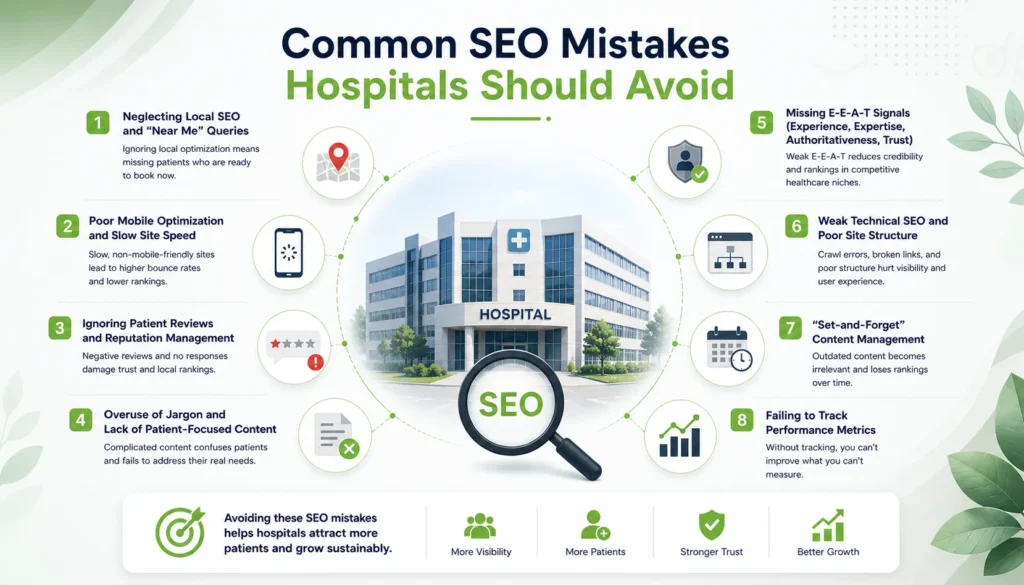
Hospitals often face unique SEO challenges due to strict compliance requirements (HIPAA), the need for local visibility, and the necessity of building trust (E-E-A-T: Experience, Expertise, Authoritativeness, and Trustworthiness).
Here are the most common SEO mistakes hospitals should avoid to maintain a strong online presence and attract patients:
1. Neglecting Local SEO and “Near Me” Queries
Patients search for nearby healthcare services, so local optimization is essential.
• Mistake: Not optimizing or updating Google Business Profile and inconsistent NAP details.
• Fix: Maintain accurate business information across all platforms and use location-based keywords to improve local visibility.
2. Poor Mobile Optimization and Slow Site Speed
Most patients search on mobile devices, especially in urgent situations.
• Mistake: Non-responsive design and slow-loading pages.
• Fix: Use mobile-friendly design, optimize images, and improve site speed for better user experience and rankings.
3. Ignoring Patient Reviews and Reputation Management
Patient reviews influence trust and local rankings.
• Mistake: Ignoring feedback or not encouraging reviews.
• Fix: Respond to all reviews professionally and actively collect patient feedback to build credibility.
4. Overuse of Jargon and Lack of Patient-Focused Content
Patients prefer simple and clear medical information.
• Mistake: Using complex medical terms or keyword stuffing.
• Fix: Create easy-to-understand, patient-focused content that answers real search queries.
5. Missing E-E-A-T Signals (Experience, Expertise, Authoritativeness, Trust)
Trust is critical for healthcare websites.
• Mistake: Publishing unverified or anonymous content.
• Fix: Add doctor credentials, author bios, and medically reviewed content to build authority and trust.
6. Weak Technical SEO and Poor Site Structure
A poorly structured website affects both users and search engines.
• Mistake: Confusing navigation and missing schema markup.
• Fix: Improve site structure and implement schema for better visibility in search results.
7. “Set-and-Forget” Content Management
SEO requires regular updates to stay relevant.
• Mistake: Outdated information and inactive blog sections.
• Fix: Update content regularly to maintain accuracy and improve rankings.
8. Failing to Track Performance Metrics
Tracking performance is essential for growth.
• Mistake: Not using analytics tools effectively.
• Fix: Monitor conversions, user behavior, and rankings to optimize your SEO strategy.
Conclusion
SEO for hospitals doesn’t work through keywords alone. Hospitals that rank higher on Google focus on trust, authority, local SEO, and patient experience together. That’s why many healthcare brands work with the best SEO specialists for hospitals to improve visibility and generate consistent patient inquiries.
At Raiseque, we’ve seen that hospitals with structured SEO systems achieve stronger long-term growth and sustainable rankings.
📩 Want a free SEO audit for your hospital website?
Comment “SEO” or message us directly.
SEO for Hospital Frequently Asked Questions
1. What is SEO for hospitals?
SEO for hospitals is the process of optimizing a hospital’s website and online presence to improve visibility on search engines like Google. It involves keyword optimization, content creation, local SEO, technical improvements, and reputation management. The goal is to help patients easily find relevant healthcare services when they search online. A well-executed SEO strategy increases website traffic, builds trust, and drives more patient inquiries by aligning content with patient needs and search intent.
2. Why is local SEO important in healthcare?
Local SEO is important in healthcare because most patients search for nearby hospitals, clinics, or doctors using location-based queries like “near me.” Optimizing for local SEO ensures that healthcare providers appear in Google Maps and local search results. It includes managing Google Business Profile, maintaining consistent contact details, and collecting patient reviews. Strong local SEO helps hospitals attract nearby patients, improve visibility in their service area, and increase appointment bookings from high-intent searches.
3. Is SEO better than paid ads for hospitals?
SEO and paid ads serve different purposes, but SEO offers long-term benefits for hospitals. SEO builds organic visibility, trust, and consistent traffic without ongoing costs per click. Paid ads provide immediate visibility and quick results but require continuous investment. A balanced strategy works best, where SEO drives sustainable growth while paid ads generate instant leads. Over time, SEO becomes more cost-effective and helps hospitals maintain a strong online presence even without active ad spending.
4. How do hospitals rank higher in google local search results?
Hospitals can rank higher in Google local search results by optimizing their Google Business Profile, using local SEO keywords, collecting positive patient reviews, maintaining accurate contact information, and publishing trusted healthcare content regularly. A fast, mobile-friendly website also improves local visibility.
5. What are the 4 P’s in healthcare?
The 4 P’s in healthcare refer to Product, Price, Place, and Promotion. Product includes the medical services offered, such as treatments and specialties. Price relates to the cost of services and transparency in billing. Place focuses on accessibility, including hospital location and online presence. Promotion involves marketing strategies like SEO, social media, and advertising. Together, these elements help hospitals attract patients, deliver value, and build a strong, competitive healthcare brand.
6. How long does SEO take for a hospital?
Hospital SEO typically takes 3–6 months to show noticeable improvements and 6–12 months for strong long-term rankings. The timeline depends on competition, website quality, content strategy, local SEO, and backlink strength. Consistent optimization helps hospitals attract more patients organically over time.
7. What is the cost of hospital SEO?
Hospital SEO costs vary based on the hospital size, competition, and services required. Small clinics may spend a few hundred dollars monthly, while large hospitals often invest thousands in advanced SEO, content marketing, and local optimization. The right strategy focuses on long-term patient acquisition and ROI.
Digital marketing for hospitals involves a patient-centric, multi-channel approach to increase visibility, build trust, and improve patient experience. It focuses on strategies like local SEO, mobile-optimized websites, targeted digital advertising, online reputation management through patient reviews, educational content marketing, and social media engagement to connect with patients effectively.
The way patients choose hospitals has completely changed. Today, before visiting a hospital, most people search on Google, read reviews, explore social media platforms, and visit the hospital’s website to evaluate credibility. A hospital’s digital presence often becomes the first point of interaction with potential patients.
Free Download: Hospital Marketing Ideas PDF
Want a ready-to-use strategy instead of reading the full guide?
Download the exact checklist hospitals use to attract more patients.
This hospital marketing ideas PDF includes practical strategies you can implement immediately.
Why Digital Marketing Matters for Hospitals
Digital marketing for hospitals is the use of online platforms to improve a hospital’s visibility, credibility, and Patient behavior has shifted rapidly in recent years. From booking appointments online to comparing hospitals through reviews and health platforms, most decisions now begin on the internet. Hospitals that are not actively present online risk losing potential patients to more visible and accessible competitors.
Marketing in healthcare is no longer limited to offline channels like print ads or hoardings. Digital marketing allows hospitals to reach the right audience with precision, improve visibility, and track performance more effectively.
Key Insights:
- A significant portion of patients in India now prefer online platforms for booking appointments.
- Digital strategies can help reduce patient acquisition costs compared to traditional methods.
- Most patients research healthcare providers online before making a decision.
These trends clearly indicate that having a strong digital presence is essential. For hospitals, clinics, and healthcare professionals, digital marketing is not just about promotion—it plays a key role in building trust, improving accessibility, and staying competitive in a digital-first world.
8 Digital Marketing Strategies to leverage
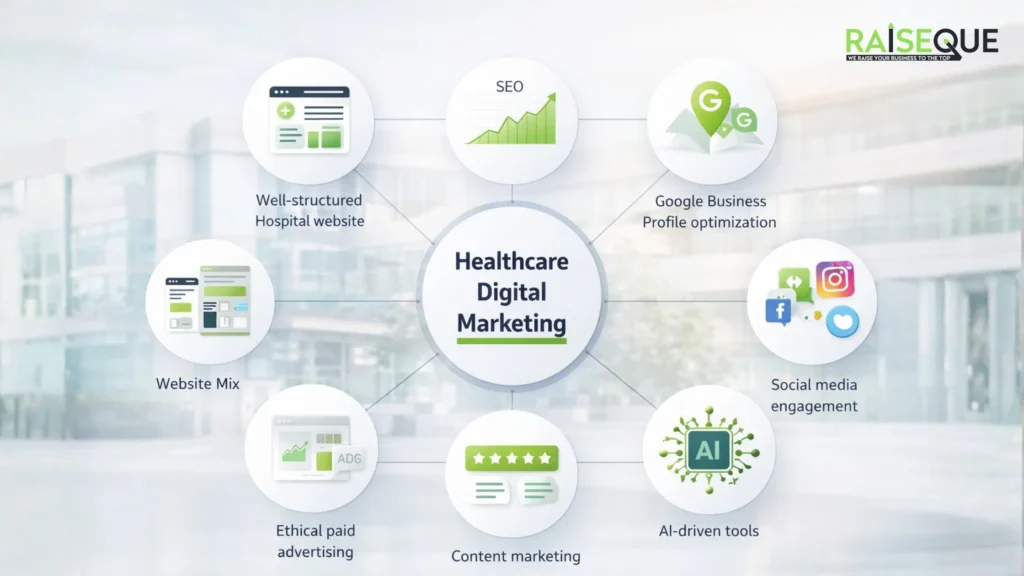
Healthcare marketing is undergoing a major shift as patients increasingly rely on digital platforms for healthcare decisions. The following strategies form the foundation of an effective hospital digital marketing approach.
- High-Quality, Mobile-Optimized Website
- Search Engine Optimization (SEO)
- Local SEO & Google Business Profile Optimization
- Social Media Engagement
- Online Reputation Management for Hospitals
- Content & Video Marketing
- PPC Advertising (Google Ads & Social Ads)
- AI-Driven Tools in Healthcare Marketing
1- High-Quality, Mobile-Optimized Website
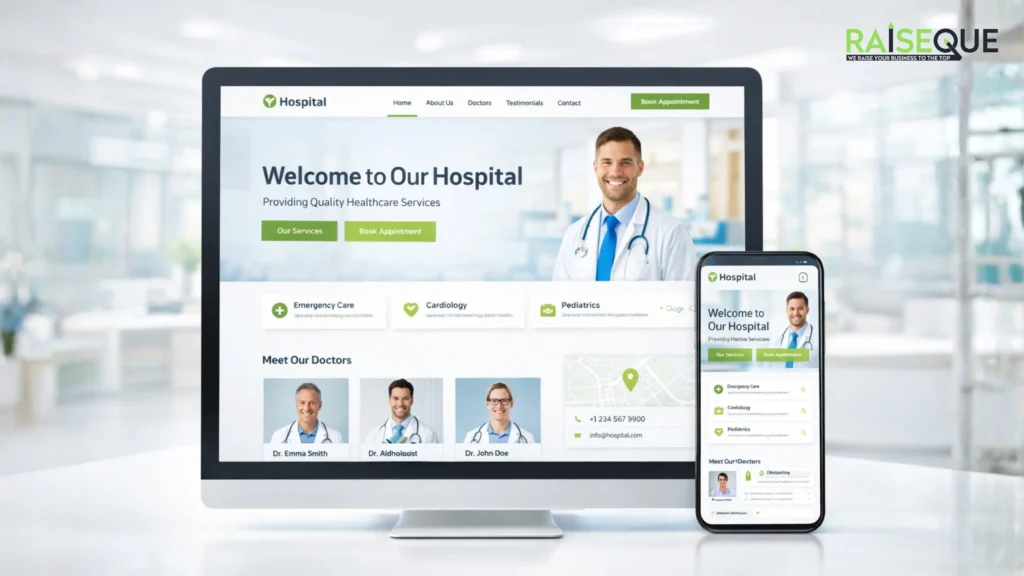
Create a fast-loading, mobile-friendly website with online booking options, patient testimonials, and detailed doctor profiles.
A well-structured hospital website is the foundation of digital marketing and often the first interaction with patients. It should be simple, mobile-friendly, and clearly present services, doctor profiles, and contact details.
Adding features like online booking and patient testimonials helps build trust, improve user experience, and increase patient conversions.
An effective hospital website should include:
- Fast loading speed for better user experience
- Mobile-responsive and accessible design
- Clear service and department information
- Verified doctor credentials and profiles
- Easy appointment booking or enquiry options
- Compliance with healthcare content guidelines
Based on industry experience, patients prefer websites that are easy to understand and quick to use. Clear language, accurate medical information, and smooth enquiry actions reduce confusion and anxiety. A strong hospital website builds credibility, improves patient confidence, and helps patients feel informed and prepared even before their first visit.
2- Search Engine Optimization (SEO) for Hospital
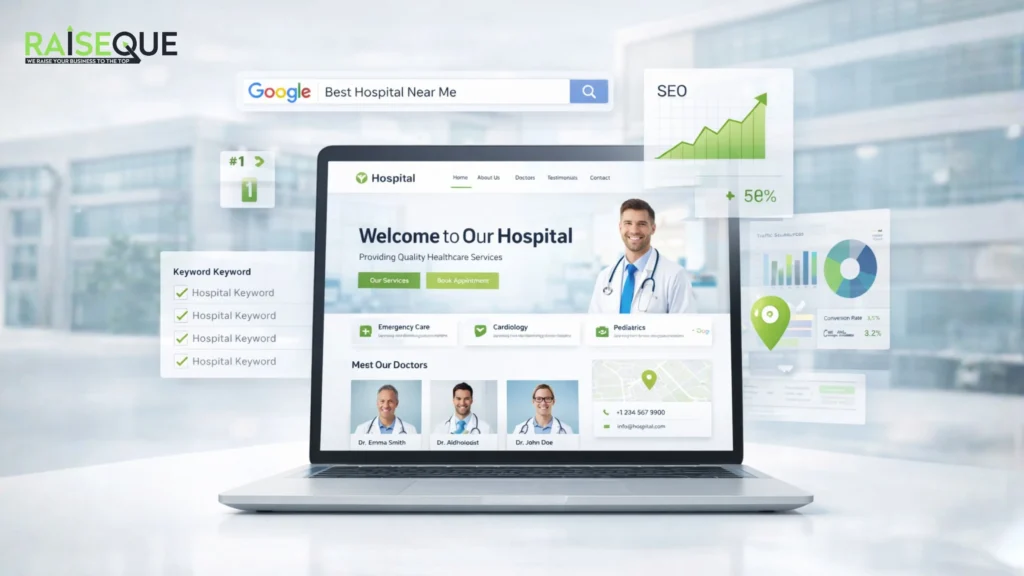
Search engine optimization helps hospitals appear in search results when patients actively look for medical services. SEO for hospital growth focuses on improving visibility for local and treatment-specific searches.
Healthcare SEO helps hospitals appear in search results when patients look for:
- Treatments
- Specialties
- Nearby hospitals
- Doctors and facilities
Important SEO elements include:
- Clear service pages
- Location-based optimization
- Accurate medical content
- Proper headings and structure
Effective SEO includes optimizing service pages, publishing educational content, strengthening local search signals, and maintaining consistent name, address, and phone information. Most hospitals face visibility challenges despite offering quality care, and SEO directly addresses this gap by connecting hospitals with patients who already have intent to seek treatment.
3- Local SEO & Google Business Profile Optimization
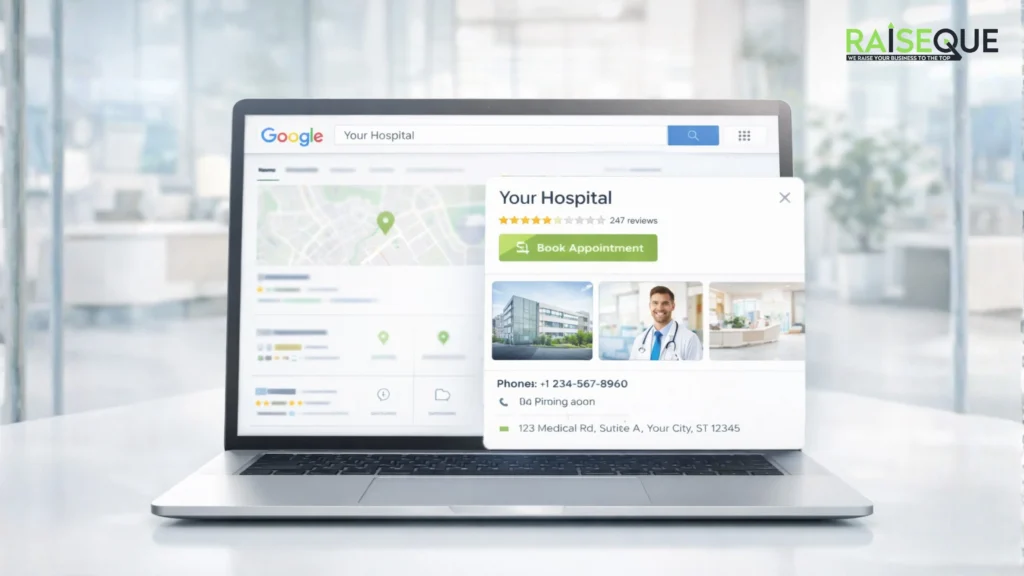
Optimize Google My Business profiles for “near me” searches to capture local patients searching for specific, immediate care.
Local search performance often depends on how effectively a hospital’s Google Business Profile is optimized.
A verified Google Business Profile improves:
- Local visibility
- Patient trust
- Appointment inquiries
Hospitals should ensure:
- Correct address and phone number
- Updated timings
- Genuine patient reviews
- Accurate service categories
An optimized profile improves visibility for “near me” searches and helps patients quickly evaluate a hospital using reviews and photos. Regular updates and professional review responses strengthen trust. In many local healthcare searches, Google Business Profiles influence patient decisions even more than websites.
Patient discovery often depends on local search presence, particularly how clinics and hospitals rank on Google Maps.
4- Social Media Engagement
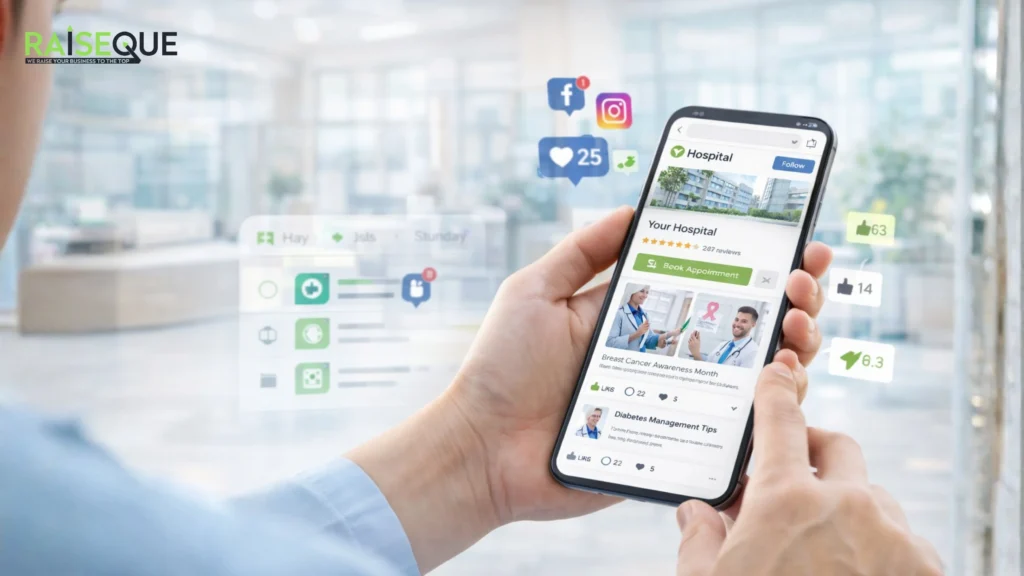
Use platforms like Facebook and Instagram to share patient success stories, health updates, and hospital events.
Social media engagement helps hospitals build awareness and connect with patients beyond clinical settings. It focuses on responsible communication, education, and trust rather than aggressive promotion.
Common uses:
- Health awareness posts
- Event updates
- Public health messages
- Emergency announcements
To understand how different platforms work in healthcare, you can explore our detailed guide on Social Media Platforms for Healthcare: A Practical Guide.
Hospitals can use social platforms to share health tips, preventive care information, doctor highlights, and important updates. From experience, hospitals that focus on education and transparency on social media develop stronger patient trust and long-term visibility.
5- Online Reputation Management for Hospitals
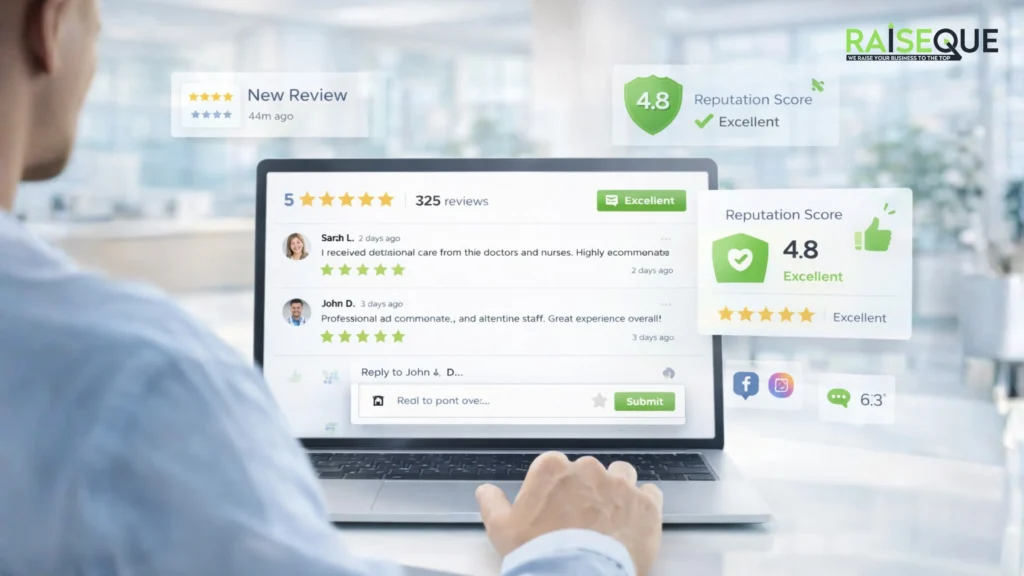
Actively monitor and respond to patient reviews on Google and social media platforms to maintain a positive brand image.
Online reputation management focuses on how a hospital is perceived through reviews and ratings on platforms like Google, which play a critical role in patient decision-making.
Patient trust is influenced by online feedback.
Hospitals should:
- Encourage genuine reviews
- Respond professionally to feedback
- Avoid fake or misleading testimonials
- Monitor review platforms regularly
Trust is built through transparency and consistency.
Managing reputation involves encouraging genuine patient feedback, responding professionally to reviews, and addressing concerns transparently. Digital tools help hospitals monitor feedback and maintain accurate listings. A strong online reputation reassures patients and reinforces trust built through other digital efforts.
6- Content & Video Marketing
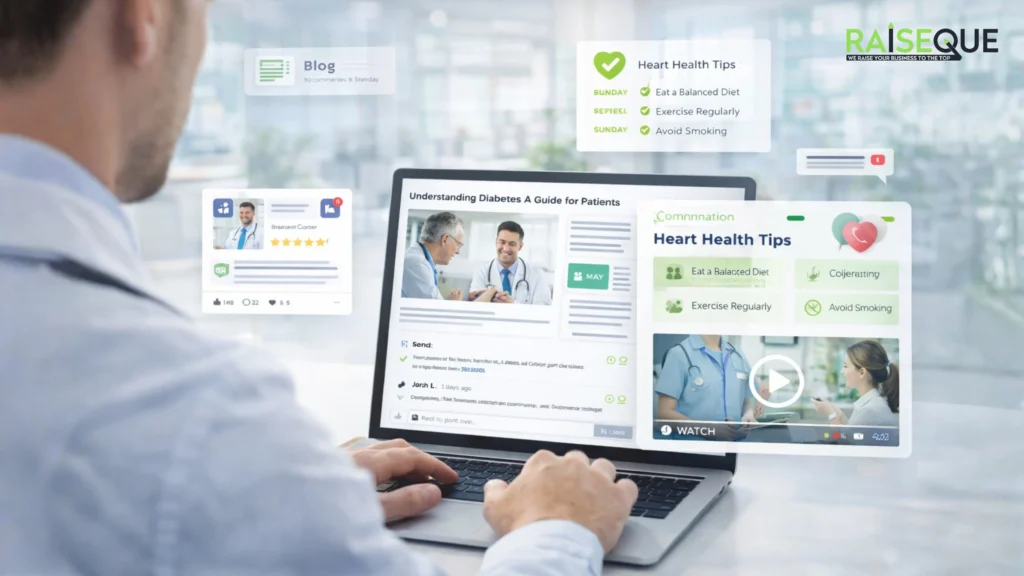
Share educational health blogs and videos to build trust and authority in specialized areas like orthopedics or cardiology.
Content marketing helps hospitals educate patients before they seek care, as most people search online to understand symptoms, treatments, procedures, and recovery expectations.
Effective hospital content marketing commonly includes:
- Informational blogs on health conditions and treatments
- Frequently asked questions (FAQs) for common patient concerns
- Preventive care and health awareness articles
- Pre- and post-treatment patient guides
- Seasonal or community health education content
Hospital content may include blogs, FAQs, awareness articles, and patient guides. Educational content that is reviewed and approved by doctors improves medical accuracy and patient trust. This approach aligns with globally recognized healthcare communication standards that emphasize clarity, accuracy, and patient-centered information. Based on real-world healthcare practices, this approach helps hospitals build credibility and positions them as reliable healthcare information sources rather than purely promotional entities.
7- PPC Advertising (Google Ads & Social Ads)
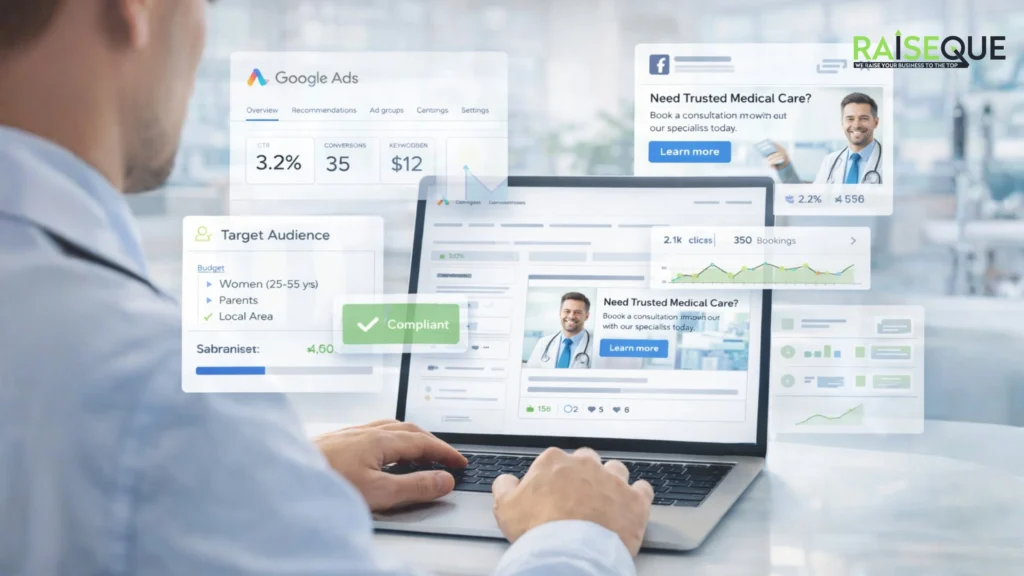
Use Google Ads and Facebook Ads to target patients by location, demographics, and specific services, driving immediate enquiries and ROI.
Ethical paid advertising can support hospital visibility when used responsibly, focusing on awareness, accessibility, and accurate information rather than exaggerated or misleading claims.
Responsible hospital paid advertising includes:
- Promoting health camps and screening programs
- Sharing awareness about medical services and facilities
- Highlighting preventive care and public health messages
- Providing clear location and contact information
- Following medical advertising and patient privacy regulations
Paid campaigns are effective for promoting health camps, services, or educational initiatives when they strictly follow healthcare advertising guidelines. When combined with organic strategies such as SEO and content marketing, ethical paid advertising enhances reach and accessibility while maintaining transparency and patient trust.
8- AI-Driven Tools in Healthcare Marketing

AI-driven tools help hospitals analyze patient behavior, optimize content performance, and improve operational efficiency. These tools assist with keyword research, trend analysis, and user experience insights.
Common applications of AI in hospital digital marketing include:
- Analyzing patient search patterns and online behavior
- Identifying high-intent healthcare keywords
- Improving website navigation and user experience
- Tracking content performance and engagement trends
- Supporting data-driven marketing decisions
When used responsibly, AI supports decision-making without replacing medical expertise. In healthcare digital marketing, AI improves consistency, efficiency, and data-driven planning while keeping patient needs, accuracy, and ethical standards at the center.
These digital marketing strategies for hospitals work together to improve visibility, build trust, and create a seamless patient experience across all digital touchpoints.
💡 Prefer a quick actionable version?
Download the Hospital Digital Marketing Checklist (PDF)
Benefits of Digital Marketing for Hospitals
• Increased Visibility: Ensures your hospital is found when patients are searching for medical help online.
• Trust and Brand Building: Showcases expertise through content and positive patient feedback.
• Measurable ROI: Unlike traditional marketing, digital efforts allow tracking of patient engagement and conversion rates, allowing for budget optimization.
• Targeted Outreach: Allows campaigns to reach specific patient populations needing specialized treatments.
In addition to these benefits, digital marketing helps hospitals improve patient engagement, provide easy access to information, and create a seamless experience across multiple touchpoints.
It also supports long-term growth by strengthening online presence, improving communication, and helping hospitals stay competitive in an increasingly digital healthcare environment.
How Can a Hospital Improve Online Patient Acquisition?
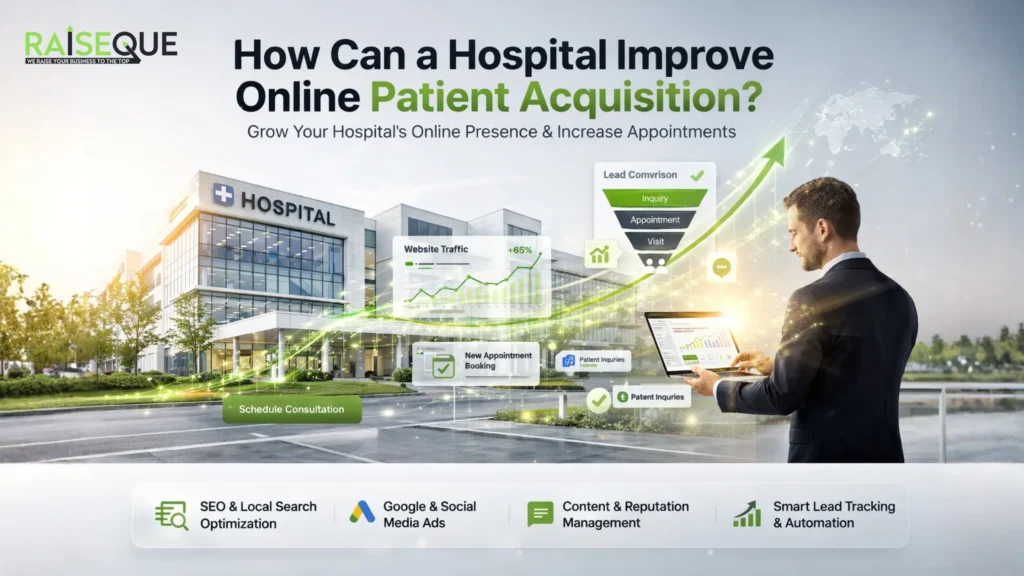
Hospitals can improve online patient acquisition by focusing on visibility, clarity, and trust across the patient’s digital journey. Most patients begin by searching online for nearby hospitals, treatments, or specialist services.
When hospitals appear consistently with accurate information and offer a clear digital experience, patients feel more confident taking the next step.
Key factors that support online patient acquisition include:
- Strong visibility in local search results for relevant healthcare queries
- A simple, well-structured website that guides patients without confusion
- Clear pre-visit information such as treatment details, consultation steps, and facilities
- An updated Google Business Profile with accurate details, reviews, and directions
- Regular educational content that builds credibility and patient trust over time
The focus should always remain on helping patients make informed decisions, not just driving website traffic.
How to Choose the Right Healthcare Digital Marketing Agency for Hospitals?
Healthcare marketing requires a different approach compared to other industries. Hospitals must communicate responsibly while building visibility and trust among patients searching for medical services online.
When selecting a digital partner, hospitals should focus on experience in healthcare communication, understanding of medical content guidelines, and the ability to deliver long-term results through ethical practices. Effective strategies rely on search engine optimization, patient-focused content, local visibility, and consistent online reputation management rather than aggressive promotion.
A specialized Healthcare Digital Marketing Agency can support hospitals by aligning digital efforts with patient search behavior and industry standards, helping improve online discoverability while maintaining credibility.
Final Thoughts
Digital marketing for hospitals is now a key part of modern healthcare communication. Patients expect hospitals to be visible online, share reliable information, and build trust before they visit. A strong digital presence helps hospitals reach the right patients, support informed decisions, and improve overall patient experience through clear and accessible information. When done ethically and transparently, digital marketing supports hospital growth while better serving patients and communities.
Frequently Asked Questions
1. Why is digital marketing important for hospitals?
Digital marketing helps hospitals increase visibility, build patient trust, and generate appointments online. Most patients search on Google before choosing a hospital, so strong online presence directly impacts patient acquisition.
2. What are the best digital marketing strategies for hospitals?
The most effective strategies include SEO, Google Business Profile optimization, paid ads, social media marketing, reputation management, and a well-designed website. Together, they attract and convert patients consistently.
3. How can SEO help hospitals attract more patients?
SEO improves a hospital’s visibility on search engines when patients search for treatments or specialists. Ranking higher builds credibility, drives organic traffic, and increases appointment inquiries without relying only on paid ads.
4. Is social media marketing effective for healthcare institutions?
Yes. Social media builds awareness, shares patient education content, highlights success stories, and strengthens brand trust. It helps hospitals connect with their local community and engage potential patients.
5. How do online reviews impact hospital growth?
Online reviews influence patient decisions significantly. Positive reviews build trust and credibility, while timely responses improve reputation. Strong review management can directly increase patient inquiries and hospital growth.
Patients no longer rely solely on word of mouth to choose doctors.
They search online, check social media, and evaluate credibility before booking appointments.
Social media for healthcare helps doctors, clinics, and hospitals educate patients, build trust, and stay visible—without violating medical ethics. Social media for healthcare plays a critical role in how patients discover, trust, and choose medical providers today.
In simple terms:
👉 If your healthcare practice is not active on social media, patients may choose someone else who is.
Why Social Media Matters More Than Ever in Healthcare
Patients today do more than search for nearby doctors. Before booking an appointment, they often check Google reviews, clinic websites, Instagram pages, and healthcare content to evaluate credibility and trust.
Social media helps doctors, clinics, and hospitals educate patients, improve visibility, and build long-term trust online. Platforms like Instagram, Facebook, LinkedIn, and YouTube allow healthcare providers to share educational content, healthcare awareness tips, treatment information, and patient-focused communication.
A strong social media presence also supports healthcare branding, patient engagement, reputation management, and local SEO visibility. Clinics that consistently educate and engage patients online are more likely to build stronger digital trust and attract new patient inquiries.
In simple terms:
👉 Patients are already searching online before choosing a healthcare provider. Social media helps your clinic stay visible, trusted, and connected throughout that decision-making process.
What Is Social Media for Healthcare?
Social media for healthcare refers to the ethical and professional use of platforms like Instagram, Facebook, YouTube, and LinkedIn by doctors, clinics, hospitals, and diagnostic centers. The purpose is not aggressive promotion, but meaningful communication that supports patient awareness and trust.
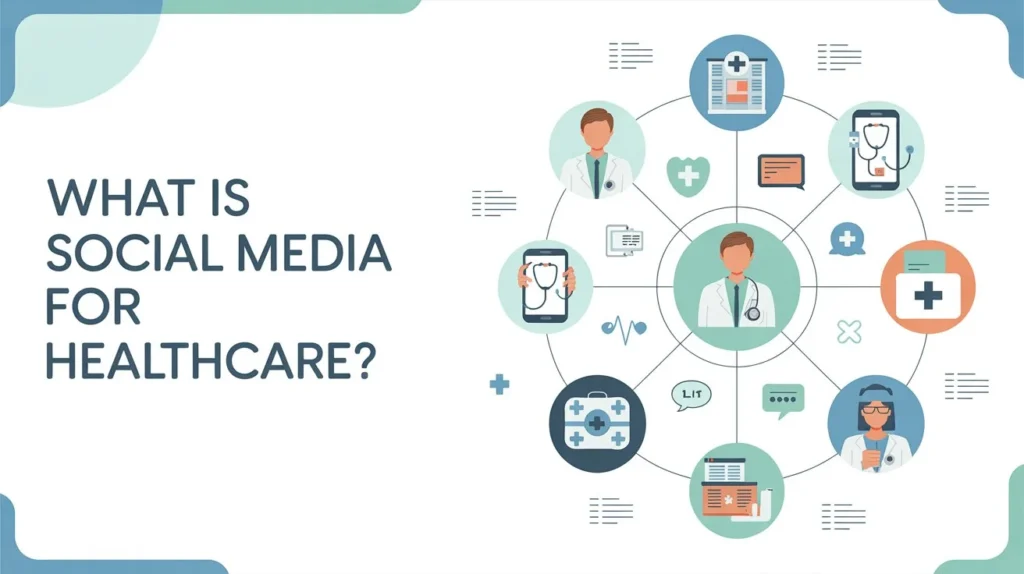
The primary objectives include:
- Patient education
- Awareness creation
- Trust building
- Community engagement
In real-world healthcare practices, patients respond more positively to informative and reassuring content than to direct marketing messages.
Healthcare Patients Are Choosing Doctors Online
Patient behavior in healthcare has changed significantly in recent years. Today, most patients research online before selecting a doctor, clinic, or hospital. They compare reviews, check social media profiles, visit websites, and watch healthcare-related videos before booking appointments.
Online trust has become one of the biggest factors influencing healthcare decisions. Patients are more likely to choose healthcare providers who have active social media profiles, educational content, positive reviews, and strong digital visibility.
Healthcare video consumption has also increased rapidly. Short educational videos, treatment explainers, doctor introductions, and healthcare awareness content help patients better understand medical services and feel more comfortable before a consultation.
At the same time, mobile-first healthcare searches continue to grow. Most patients now search for nearby clinics, doctors, and healthcare services directly from their smartphones. This makes social media visibility and consistent online engagement essential for modern healthcare practices.
In simple terms:
👉 Patients are researching healthcare providers online before making decisions. Clinics that build trust digitally are more likely to attract and convert new patients.
Why Is Social Media Important for Healthcare?
Patients today begin their healthcare journey online. Before booking an appointment, they often look for doctor profiles, clinic updates, and educational content to assess credibility. Social media plays a critical role in shaping these early impressions.
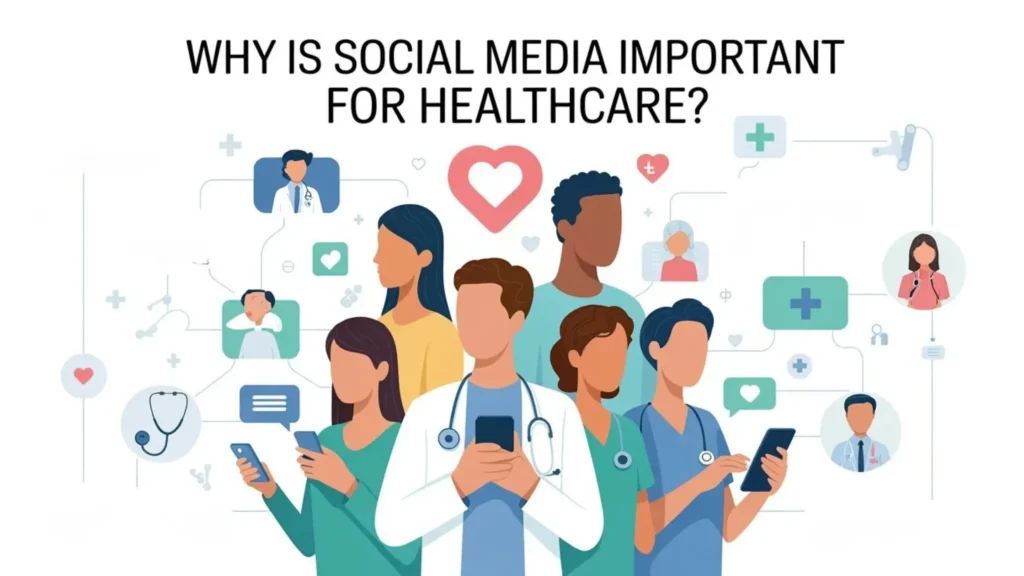
Social media has become an extension of the patient decision journey, where trust is built long before a clinic visit occurs. When healthcare providers consistently share accurate and easy-to-understand information, they position themselves as reliable sources rather than advertisers.
Based on industry experience, patients are more likely to choose doctors who communicate clearly and educate openly online, as this reduces uncertainty and increases confidence in the quality of care.
Which Social Media Platforms Are Best for Healthcare?
Different platforms serve different healthcare communication needs, and effectiveness depends on patient behavior rather than trends.
- Instagram: Ideal for short educational videos, reels, and visual trust-building
- Facebook: Useful for local visibility, community engagement, and clinic updates
- YouTube: Best for in-depth explanations, procedure education, and long-form guidance
- LinkedIn: Supports professional credibility, hospital branding, and peer networking
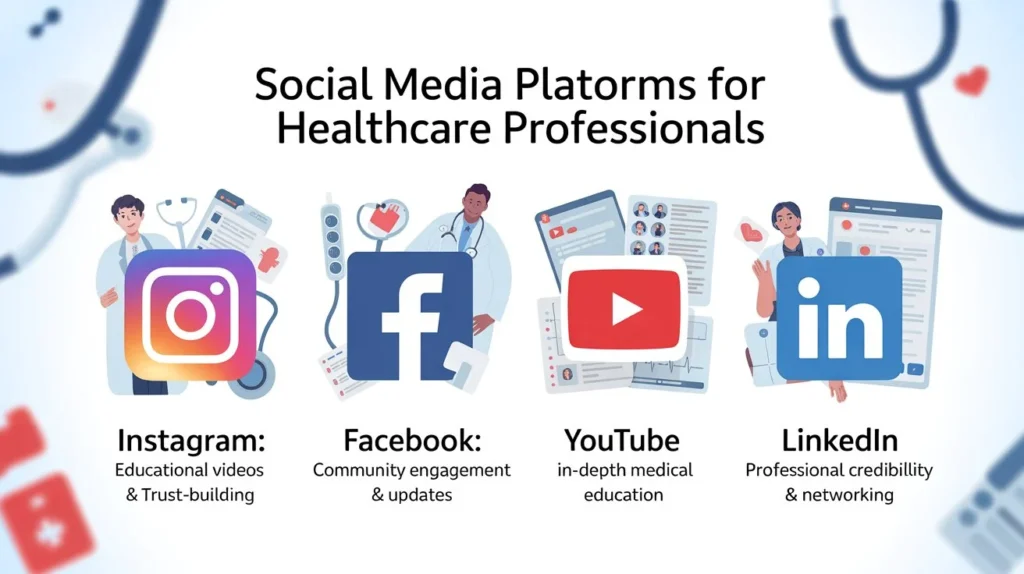
The effectiveness of a platform depends on how patients consume information. Visual and video-based platforms simplify complex medical topics, while text-driven platforms strengthen professional authority. Most clinics benefit more from consistent activity on one or two platforms rather than trying to manage all channels at once.
A well-planned social media for healthcare strategy focuses on education, ethical communication, and long-term trust building.
What Type of Content Works Best in Healthcare?
Healthcare audiences prefer content that is educational, ethical, and easy to understand. The focus should always be on patient value rather than promotion.
High-performing healthcare content includes:
- Symptom awareness posts
- Preventive care tips
- Patient FAQs
- Health awareness campaigns
- Doctor introduction videos
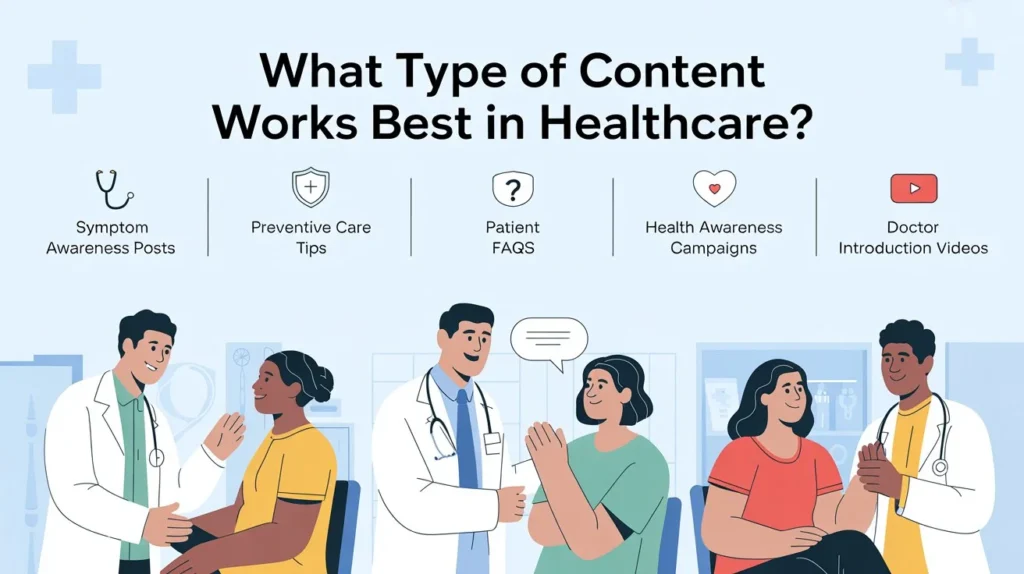
Healthcare audiences respond best to content that prioritizes clarity and reassurance. Educational posts that address real patient concerns help reduce fear and misinformation. In most clinics, reels and short videos perform better than static posts because patients find visual explanations more relatable and easier to follow.
Ethical Guidelines for Social Media in Healthcare
Ethics are non-negotiable in healthcare communication. Social media content must always respect patient safety, privacy, and professional boundaries.
Key ethical practices include:
- No online diagnosis
- No misleading or exaggerated claims
- No guaranteed treatment outcomes
- Patient consent for testimonials
- Clear medical disclaimers
Ethical content protects both patients and healthcare providers. Clinics that follow these guidelines not only comply with regulations but also earn long-term trust, as patients value transparency and responsibility over sensational messaging.
Common Mistakes Clinics Make on Social Media
Many healthcare providers struggle with social media, not because of a lack of intent, but because of a lack of strategy.
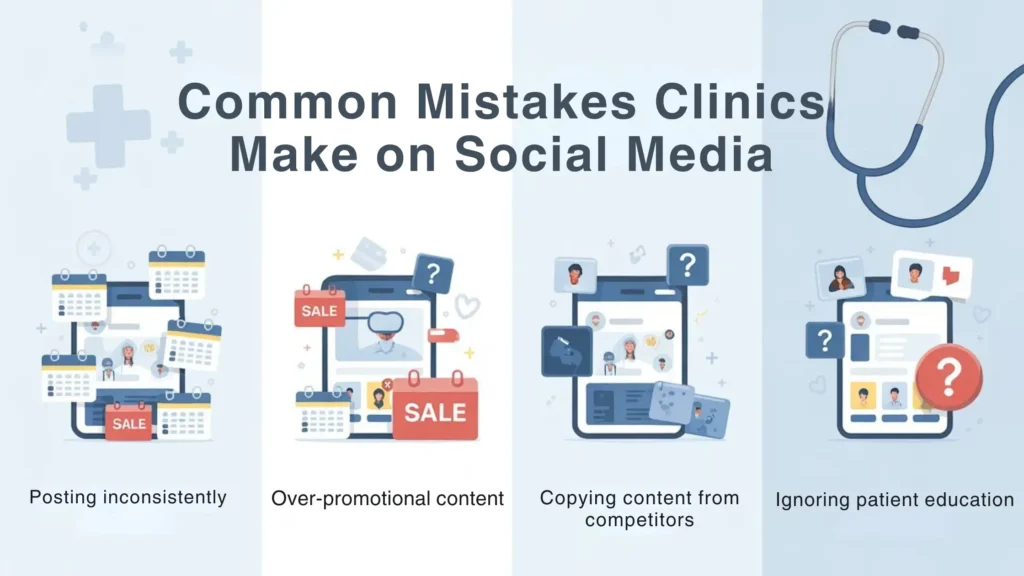
Common mistakes include:
- Posting inconsistently
- Over-promotional content
- Copying content from competitors
- Ignoring patient education
Most clinics face this challenge: they deliver excellent care offline but fail to communicate it effectively online.
How Social Media Supports Healthcare SEO
Social media does more than increase engagement — it also supports healthcare SEO and online visibility. When patients interact with your content, search for your clinic online, visit your website, or leave reviews, it sends strong trust and relevance signals to Google.
Active social media profiles can help clinics:
- Improve brand visibility
- Increase website traffic
- Strengthen Google Maps’ presence
- Build patient trust through reviews and engagement
- Support local SEO performance
When combined with local SEO, Google reviews, and website optimization, social media becomes a powerful part of long-term patient acquisition.
Future of Social Media in Healthcare
Healthcare communication is rapidly evolving, and social media will continue to play a central role.
The future will focus on:
- Video-first education
- Patient-centric communication
- AI-driven content discovery
- Preventive health awareness
Short-form videos, personalized content, and technology-assisted engagement will define the next phase of healthcare social media. Doctors and clinics that adapt early—while maintaining ethical standards—will remain visible, trusted, and competitive in the digital healthcare landscape.
Conclusion
Social media for healthcare is no longer optional—it is a critical communication channel that shapes how patients discover, evaluate, and trust healthcare providers.
When used responsibly, social media for healthcare becomes a powerful tool for patient education and digital credibility.
When used responsibly, it allows doctors and clinics to educate patients, reduce misinformation, and build lasting credibility. As patient behavior continues to shift online, healthcare practices that invest in ethical, consistent social media communication will be better positioned to build trust and relevance both online and offline.
Related Blog:
Social Media Platforms for Healthcare | Social Media Marketing for Doctors| Instagram Marketing for Doctors| Facebook Marketing for Clinics| Social Media Marketing Mistakes| LinkedIn Branding for Doctors| Facebook Ads for Clinics| YouTube Marketing for Healthcare
A doctor’s website helps improve online visibility, build trust, simplify appointment booking, educate patients, and make communication easier. It also supports practice growth by offering 24/7 access to information, strengthening reputation, and helping clinics compete in a digital-first healthcare market.
A strong website does much more than just create an online presence. It strengthens your overall digital presence, helps patients easily discover your services, builds trust, and supports long-term practice growth. When people talk about the benefits of website for doctors, they are really referring to visibility, convenience, credibility, and a better patient experience working together.
Whether you run a private practice, specialty clinic, or work in a hospital setting, understanding why doctors need a website is now essential. A well-structured website helps patients access treatment information, view your doctor profile, check clinic timings, and complete online appointment booking without confusion or delay.
Top Doctor Website Benefits at a Glance

Some of the most valuable doctor website benefits include:
- better Google visibility through local SEO
- stronger trust through a complete doctor profile
- easier online appointment booking
- access to clinic details like address, services, and clinic timings
- better patient communication through a contact form
- stronger credibility through patient testimonials
- support for teleconsultation and digital care
- smoother access through a mobile-friendly website
- improved online reputation
- stronger healthcare branding
These medical practice website benefits apply to both individual doctors and larger healthcare businesses. In the same way, the benefits of website for clinics include making the patient journey easier while helping the practice become more visible and professional online.
10 Reasons Why Every Doctor Needs a Website
Here are the top 10 reasons why every doctor need a website. A professional website is essential for modern doctors to build credibility, attract new patients, and manage their practice more efficiently. It acts as a 24/7 digital front desk where patients can access information, book appointments online, and communicate easily. A well-designed website also improves visibility, strengthens reputation, supports patient education, and helps doctors stay competitive in today’s digital healthcare environment.
Key Benefits of a website for doctors include:
1. Establishing Trust & Credibility
One of the biggest benefits of website for doctors is trust-building. Before choosing a healthcare provider, many patients want to know who the doctor is, what services are offered, and what kind of experience they can expect.
A professional website makes this easier by clearly presenting your doctor profile, qualifications, areas of specialization, experience, awards, and affiliations. It can also include patient testimonials, which help reassure first-time visitors that others have had a positive experience with your clinic.
This is where the importance of website for doctors becomes very real. Patients often decide whether to contact a clinic based on how credible and complete its online presence looks.
2. Increased Visibility & Marketing
Another major reason why doctors need a website is discoverability. Patients now rely heavily on search engines when looking for nearby healthcare services. A website helps your practice show up for relevant searches and strengthens your digital presence.
With the right structure, content, and local SEO strategy, your website can appear when people search for terms like “dentist near me,” “orthopedic doctor in [city],” or “skin specialist near me.” Adding service-specific pages, location details, and useful content helps Google understand what your practice offers and who it serves.
This is one of the strongest medical practice website benefits, because it helps bring in patients who are already searching for care.
To get even better results from your website, doctors should also focus on local SEO for clinics and doctors, which helps improve Google visibility and attract more nearby patients.
3. Convenience & Accessibility
Convenience matters a lot in healthcare. One of the most practical doctor website benefits is making it easier for patients to take the next step.
A website with online appointment booking allows people to schedule a consultation without waiting for clinic hours. Instead of needing multiple calls, patients can simply choose a suitable time and submit their request. A clear contact form can also help patients ask questions or request a callback if they need more information before booking.
For both doctors and clinics, this is one of the most useful benefits of website for clinics, because it reduces friction and improves patient conversion.
A well-planned doctor website design also makes the booking journey simpler by placing appointment buttons, contact details, and inquiry forms where patients can easily find them. This is why medical website development is not just about appearance—it directly affects patient experience and conversion.
4. Gives Patients 24/7 Access to Important Information
Your website works all the time, even when your clinic is closed. Patients can check clinic timings, address, available services, consultation days, fees, and basic treatment information whenever they need it.
This round-the-clock accessibility is one of the often-overlooked benefits of website for doctors. A patient who cannot call during working hours can still get answers from your website and move closer to booking an appointment.
Adding features like Google Maps integration also makes it easier for patients to find your clinic location without confusion. This small detail improves user experience and supports local search relevance at the same time.
5. Patient Education
Patients often search online to understand symptoms, conditions, and treatment options before consulting a doctor. A website allows you to publish blogs, FAQs, and service pages that provide reliable patient education in simple language.
This is one of the strongest medical practice website benefits because it helps patients make better decisions while also improving topical authority in search engines. Educational content can cover preventive care, treatment procedures, recovery guidance, and frequently asked questions related to your specialty.
When a doctor consistently shares useful content, it strengthens both healthcare branding and patient trust.
6. Improved Patient Engagement
A website can make communication smoother and more organized. Patients should be able to reach your practice easily, and a well-built website supports that through a contact form, click-to-call options, WhatsApp integration, and clear inquiry pathways.
Some practices also use a patient portal to help patients securely access records, follow-up instructions, reports, or appointment details. Depending on your setup, this can improve convenience and reduce repeated back-and-forth communication.
Among the many doctor website benefits, better patient engagement is a big one because it improves the overall experience before and after the consultation.
7. Supports Online Reputation Management
Your online reputation plays a major role in how patients evaluate your practice. A website gives you more control over that reputation by acting as the central source of accurate and updated information.
You can highlight recognitions, certifications, media mentions, service quality, and patient testimonials in a professional format. Instead of relying only on third-party review platforms, your own website becomes the place where patients can understand your values, strengths, and expertise.
This is one of the long-term benefits of website for doctors, especially in competitive specialties where trust heavily influences decision-making.
8. Reduced Administrative Load
A good website can save time for your front-desk team and reduce repetitive questions. When patients can easily find clinic timings, treatment-related FAQs, consultation details, and directions, your staff spends less time answering the same queries again and again.
Features like online appointment booking, a contact form, and even a patient portal can help streamline communication and reduce manual workload. That makes operations smoother and allows staff to focus more on patient care.
This is one of the most practical benefits of website for clinics, especially for growing practices that want efficiency as well as better marketing results.
9. Supports Teleconsultation and Digital Care
As healthcare continues to evolve, digital convenience is becoming more important. Another clear example of why doctors need a website is that it can support teleconsultation, remote follow-ups, and online care coordination.
A website can explain how virtual consultations work, who they are suitable for, what technology is needed, and how patients can request one. This improves clarity and gives your practice a more modern, accessible feel.
Even simple digital features can strengthen your digital presence and make your clinic more appealing to today’s patients.
10. Competitive Advantage
Patients often compare several providers before choosing one. A clinic with a clean, informative, mobile-friendly website usually has a clear advantage over one with little or no online presence.
That is why the importance of website for doctors goes beyond branding alone. A website helps you stand out by combining trust, visibility, convenience, and professionalism in one place. It also supports stronger healthcare branding, which helps patients remember your practice and associate it with quality care.
Among all doctor website benefits, competitive advantage is one of the biggest for long-term growth.
Why Every Doctor Needs a Website Today

The answer to why doctors need a website is simple. Patients now expect healthcare providers to be easy to find, easy to understand, and easy to contact online.
A professional website helps doctors strengthen their digital presence, improve online reputation, provide patient education, and support key functions like online appointment booking, teleconsultation, and easier access to treatment information. It creates a better first impression and supports a smoother patient journey.
For both individual practitioners and larger clinics, the medical practice website benefits are now too important to ignore.
Frequently Asked Questions
What are the main benefits of website for doctors?
The main benefits of website for doctors include better search visibility, stronger credibility, easier booking, improved patient communication, better online reputation, and long-term practice growth.
Why do doctors need a website today?
Why doctors need a website comes down to patient behavior. Most people now research healthcare providers online before booking, and a website helps doctors build trust, share treatment information, and make access easier.
What are the medical practice website benefits for clinics?
Some of the top medical practice website benefits include stronger local SEO, improved communication, easier online appointment booking, more effective healthcare branding, and a better patient experience.
What are the benefits of website for clinics?
The benefits of website for clinics include 24/7 access to clinic details, easier inquiries through a contact form, better discoverability with Google Maps integration, and smoother communication overall.
What is the importance of website for doctors?
The importance of website for doctors lies in visibility, trust, convenience, and growth. A website supports your digital presence, improves patient experience, and helps your practice stay competitive.
Conclusion
The benefits of website for doctors go far beyond just being online. A strong website helps build trust, improve local SEO, support patient education, simplify communication, strengthen online reputation, and make care more accessible through features like online appointment booking and teleconsultation.
As more patients search online before choosing a healthcare provider, the importance of website for doctors will only continue to grow. Whether you run an individual practice or a larger clinic, investing in a professional, mobile-friendly website gives your practice a stronger foundation for long-term success.
How Raiseque Can Help
Raiseque helps doctors, clinics, and healthcare brands create websites that improve trust, visibility, and patient conversion. With the right mix of design, content, local SEO, and healthcare branding, we build websites that help medical practices grow online. To get started, contact us and let’s discuss your requirements.
Are you a healthcare provider looking to drive more local patients to your practice?
If so, the best way to gain the visibility you want for your clinic, hospital, or private practice is through local search engine optimization (SEO). By investing in Local SEO for Healthcare, you help more nearby patients discover your services right when they need them—via Google Search, Google Maps, and other local platforms.
In this comprehensive guide, we’ll walk you through everything from the basics to advanced tips so your practice ranks higher, reaches more people, and stays ahead of the competition.
Why Local SEO Matters for the Healthcare Industry

Today, healthcare decisions often begin with a quick Google search.
When a potential patient searches for terms like:
- “ENT specialist near me”
- “child specialist in [City]”
- “emergency dental care in [Area]”
their first point of contact is often Google Maps or local listings.
Key Stats:
- 88% of local searches on mobile result in a visit or call within 24 hours
- 76% of people who search for healthcare services nearby visit a provider within a day
- 91% of patients read online reviews before choosing a doctor
That’s why Local SEO for healthcare providers isn’t just an option—it’s essential for modern practice growth.
What Is Local SEO for Healthcare?

Local SEO for Healthcare is the process of optimizing a clinic or hospital’s online presence so it appears accurately and prominently when patients search for medical services in a specific geographic area. Unlike general local SEO used for retail or service businesses, healthcare-focused local SEO is built around trust, credibility, and accuracy rather than promotions or quick rankings.
It ensures that essential information—such as clinic location, doctor details, services offered, and operating hours—is consistent and reliable across Google Search, Google Maps, and other local platforms, helping patients make confident decisions at the right moment.
What makes Local SEO for Healthcare different is the way Google evaluates medical-related information. Healthcare falls under Google’s Your Money or Your Life (YMYL) category, meaning higher quality and trust standards apply. This requires clinics and hospitals to focus on doctor credentials, ethical content, genuine patient reviews, and real-world experience alignment rather than aggressive keyword tactics.
Since most patients search locally—often during urgent or high-intent moments—Local SEO for Healthcare plays a critical role in connecting clinics with nearby patients by combining location relevance, clinical credibility, and patient trust into a single, reliable digital presence.
Why Local SEO for Healthcare Matters for Clinics and Hospitals ?
Local SEO for Healthcare matters for clinics and hospitals because it directly influences how patients discover, evaluate, and choose medical providers in their immediate area.
Today, most patients begin their healthcare journey with a location-based Google search, and clinics that appear in local results and Google Maps are perceived as more accessible, trustworthy, and relevant—often regardless of size or brand recognition.
For clinics and hospitals, Local SEO for Healthcare is not just about visibility but about building confidence at the moment of decision. Accurate listings, credible reviews, clear doctor information, and strong local signals help patients feel assured that they are choosing a reliable medical facility, which ultimately leads to more calls, visits, and long-term trust without relying heavily on paid advertising.
What is Local SEO for Doctors, Hospitals, and Health Systems?

Local SEO refers to the process of optimizing your online presence so your healthcare practice appears in local search results, especially on platforms like Google Maps, Local 3-Pack, and location-based searches.
Unlike general SEO, which targets national or global audiences, local SEO focuses on people near your clinic, making it highly targeted and more effective for converting online visibility into real patient visits.
It includes elements like:
- Google Business Profile optimization
- Localized keywords
- Consistent NAP (Name, Address, Phone number)
- Local citations
- Reviews and ratings
- Mobile-friendly design
- Structured data (schema markup)
15 Effective Strategies to Boost Your Local Healthcare SEO

1. Optimize Your Google Business Profile (GBP)
Claim and verify your listing on Google Business Profile. This is the single most impactful thing you can do for local visibility.
Fill in all details:
- Clinic name
- Address and accurate map pin
- Phone number (clickable)
- Website URL
- Appointment link
- Business hours (including holidays)
- List of services
- Categories and attributes (e.g., women-led, wheelchair accessible)
Post weekly updates and add high-resolution photos of your clinic, staff, and services.
2. Use Local Keywords Strategically
Use search phrases that your local patients actually search for. Examples:
- “Eye clinic in Hyderabad”
- “Best gynecologist near South Delhi”
- “Pediatric hospital open today in Bangalore”
Add these naturally in:
- Page titles
- Meta descriptions
- Image alt tags
- Google posts
- Service pages
Use tools like Google Keyword Planner or Ubersuggest to discover trending local queries.
3. Create Location-Specific Landing Pages
If you operate in multiple cities or areas, create separate landing pages for each location.
Each page should include:
- Local keywords
- Google Maps embed
- Unique content
- Address and NAP details
- Local testimonials or case studies
4. Utilize Schema Markup
Schema markup helps search engines understand your website better.
For healthcare, use Local Business and Medical Business schema. Include:
- Clinic name
- Location
- Reviews
- Services
- Opening hours
- Price range
Tools like Merkle’s Schema Markup Generator can help you get started.
5. Build Local Citations
List your practice on reputable healthcare directories:
Ensure consistency in:
- Clinic name
- Address
- Phone number
Inconsistent listings confuse Google and hurt your rankings.
6. On-Page Optimization is Just as Important
Make sure your site is SEO-friendly:
- Use clean URL structures: /services/dental-care-bangalore
- Internal linking between related service pages
- Fast loading speeds (under 3 seconds)
- Mobile-friendly design (most searches are on phones)
- Secure with HTTPS
7. Leverage Social Media for Local Reach
Social signals indirectly influence local SEO. Share:
- Clinic updates
- Patient testimonials (with consent)
- Health tips relevant to your area (e.g., “Avoid heat stroke this summer in Chennai”)
Engage with local followers and reply to comments to build trust and relevance.
8. Use Google Posts
Google Business Profile lets you post updates like:
- Promotions
- Holiday closures
- New services
- Patient education
Each post can include a call-to-action (CTA) like “Book Now” or “Learn More.”
9. Encourage Patient Reviews
Reviews are critical for both trust and rankings.
Ways to gather reviews:
- Ask happy patients post-appointment
- Share a direct review link via WhatsApp or SMS
- Display a QR code at your front desk
Respond to every review to show you care and improve engagement.
10. Monitor Your Online Reputation
Use tools like:
Monitor mentions, reviews, and feedback across the web. Address negative comments professionally.
11. Optimize for Mobile Devices
Most patients search using smartphones.
- Use large fonts and tap-friendly buttons
- Avoid intrusive pop-ups
- Compress images for faster load times
Use Google’s Mobile-Friendly Test to check your site.
12. Localize Your Content
Write blog posts about local topics:
- “Monsoon skin care tips in Mumbai”
- “Flu prevention for Delhi winters”
Also include:
- Testimonials from local patients
- Clinic case studies from your city
- Videos of local events or camps
13. Partner with Local Businesses
Form partnerships with:
- Gyms
- Pharmacies
- Yoga centers
This can result in:
- Cross-promotions
- Local backlinks
- Word-of-mouth marketing
14. Utilize Online Ads
Use Google Ads with location targeting:
- Target by city, zip code, or radius
- Use call-only ads for emergency care
- Schedule ads for clinic hours
Combine organic and paid search for maximum exposure.
15. Measure and Analyze Performance
Track metrics using:
Key metrics:
- Website clicks
- Direction requests
- Appointment bookings
- Page load speeds
Use insights to improve underperforming pages or campaigns.
What Does It Take To Rise to the Top?
The top-ranking clinics don’t always have the most expensive websites—they have the most consistent, complete, and trustworthy local SEO strategies.
What Google looks for:
- Active engagement on GBP
- Regular updates and fresh content
- High-quality, genuine reviews
- Fast and mobile-optimized sites
- Relevance to search queries
By following best practices and optimizing over time, you can rise to the top of local search results.
Start Using Local SEO for Healthcare Today
Getting started doesn’t need to be overwhelming. Start with your Google Business Profile—then gradually work on reviews, content, citations, and ads.
Stay patient. Local SEO is a marathon, not a sprint. But done right, the results will be worth it.
Explore Our Health & Wellness Case Studies
We’ve helped healthcare clients across India and abroad grow their practice online. Examples:
- An Ayurveda clinic in Kerala grew traffic by 300% in 6 months
- A physiotherapy center in Delhi increased booking conversions by 2.5x
- A multi-specialty hospital in Bangalore saw a 40% jump in local map visibility
Want to be our next success story?
Solving Key Challenges for Healthcare Providers
We understand the unique pain points you face:
- Maintaining online credibility
- Dealing with negative reviews
- Low patient engagement on social media
- Not appearing in the top 3 Google results
Our strategies are tailored specifically for clinics, hospitals, and individual doctors looking to grow with ethical, result-driven local SEO.
Read – How Google Maps Ranking for Clinics and Hospitals Works
Local SEO Guide for Clinics and Doctors
Why Clinics Are Not Getting Patients (And What You Can Do About It)
Why New Clinics Fail in the First Year (And What Most Doctors Get Wrong)
SEO Audit Guide: A Complete Step-by-Step Checklist to Improve Rankings, Traffic, and Website Performance
FAQs – People Also Ask
Q1. What is local SEO for healthcare providers?
Local SEO is the process of optimizing your clinic’s online presence to appear in Google’s local results and Maps when potential patients search for services nearby.
Q2. How can I improve my clinic’s local SEO?
Start by optimizing your Google Business Profile, adding local keywords, collecting reviews, and building consistent online citations.
Q3. How long does it take to see results?
You may start seeing improvements within 1–3 months, but consistent growth takes 6–12 months with ongoing efforts.
Q4. Should I combine local SEO with paid ads?
Yes, combining organic local SEO with geo-targeted Google Ads can help you reach more patients faster.
Q5. Do Google reviews affect my ranking?
Absolutely. Quantity, quality, and frequency of reviews impact your visibility on Google Maps and search.
Conclusion: Why Local SEO for Healthcare Truly Matters
Clinics and hospitals that understand Healthcare Local SEO gain more than visibility on Google—they build patient trust before the first consultation even happens. In healthcare, credibility always outweighs clicks. Patients choose providers who appear reliable, transparent, and locally relevant, which is why local visibility must be built carefully, ethically, and strategically rather than rushed or over-optimized.
When implemented the right way, Local SEO for Healthcare aligns online presence with real clinical experience. Accurate Google Maps listings, consistent clinic information, meaningful reviews, and location relevance work together to reassure patients that they are choosing the right provider. This trust-driven approach reflects the long-term growth philosophy followed by teams focused on ethical healthcare visibility, such as those at Raiseque.
If you are evaluating whether Local SEO for Healthcare is the right step for your clinic or hospital, the first move should not be buying a package. It should be understanding where your current visibility stands, how patients in your area search, and what gaps exist in your local presence. A structured assessment or professional consultation can help clarify this path and set realistic expectations. If required, you can explore the next steps through the Contact Us page.
Done correctly, Healthcare Local SEO is not just marketing—it is a form of digital reputation management that supports sustainable growth, patient confidence, and long-term trust in modern healthcare.
Most patients today search “clinic near me”, “hospital near me”, or “healthcare services nearby” before making a decision.
The first thing they usually see is your Google Business Profile (GBP).
Direct answer:
Google Business Profile optimization for healthcare helps clinics and hospitals improve local visibility, appear in Google Maps results, and build patient trust before the first visit.
This guide explains what to optimize, why it matters, and how healthcare organizations should manage their Google Business Profile correctly.
What Is a Google Business Profile in Healthcare?
A Google Business Profile is a free Google listing that displays your healthcare facility on:
- Google Search
- Google Maps
- Local “near me” results
For healthcare providers, it typically includes:
- Clinic or hospital name
- Healthcare category and services
- Address and phone number
- Reviews and ratings
- Operating hours
- Photos and updates
In real-world healthcare practices, this profile often drives more patient actions than the website itself.
Why Google Business Profile Optimization for Healthcare Is Important
1. Improves Local Visibility
Google uses GBP signals to determine:
- Local Pack inclusion
- Google Maps ranking
- Nearby healthcare recommendations
2. Builds Patient Trust
Patients evaluate healthcare providers based on:
- Reviews
- Accurate information
- Visual proof of the facility
Most healthcare clinics face this challenge: strong clinical expertise but weak online trust signals.
3. Drives High-Intent Actions
GBP users are ready to:
- Call the clinic
- Get directions
- Book appointments
Your Google Business Profile is the first impression many potential patients have of your practice. When someone searches “pediatrician near me” or “best skin doctor in [Your City]”, Google Maps and local listings appear at the top. That’s your chance to be seen—and chosen.
A well-optimized profile:
- Ranks higher in local search
- Builds credibility and trust
- Encourages more bookings
- Brings patients straight to your clinic
You can also Read: What Is Local SEO for Healthcare? and Why It Matters for Clinics and Hospitals
Step-by-Step: How to Optimize Google Business Profile for Healthcare
If you don’t have Google Business Profile the read this blog: How to List Your Business on Google: The Complete Guide 2025
1. Claim and Verify Your Listing
This is the most important step.
Go to Google Business Profile Manager, find your clinic, and claim the listing.
Then, verify it by postcard, phone, or email to take full control.
2. Complete Every Section of Your Profile
Google favors complete and accurate listings. Here’s what to focus on:
Business Description
Write a clear and friendly paragraph that explains:
- Who you are
- Your specialty (e.g., Dermatologist, Pediatrician, etc.)
- What makes your care unique
Use keywords like “skin doctor in Mumbai” or “child specialist in Delhi” naturally.
Categories

Choose the right primary and secondary categories:
- Primary: “General Practitioner,” “Dental Clinic,” or “Orthopedic Surgeon”
- Secondary: “Weight Loss Service,” “Vaccination Clinic,” etc.
Services
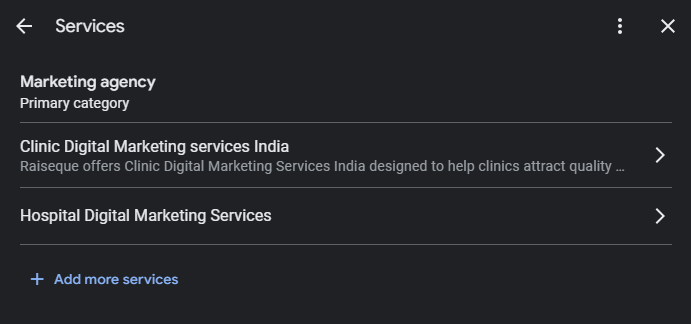
List all your services:
- General Consultation
- Lab Testing
- Dental Implants
- Blood Pressure Monitoring
Each service should include a short description with keywords.
Attributes
Let people know what to expect:
- Wheelchair accessibility
- Online consultation
- Female doctor available
- Languages spoken (English, Hindi, etc.)
Contact Details & Hours
Ensure your:
- Phone number is correct and active
- Address is accurately pinned
- Website link is working
- Opening hours are regularly updated (including holidays)
3. Add High-Quality Photos and Videos
Photos help patients trust your clinic even before they visit.
What to Upload:
- Clinic exterior & signage
- Reception & waiting area
- Staff & doctors (with permission)
- Consultation rooms & equipment
Bonus: Add a short video tour or a friendly doctor introduction to boost engagement.
4. Collect and Respond to Reviews
Reviews are one of the strongest local ranking factors for Google.
How to Get More Reviews:
- Ask patients kindly after their appointment
- Send a follow-up SMS or WhatsApp with a review link
- Use QR codes at your front desk
Always Respond:
- Thank positive reviewers
- Address concerns from negative reviews professionally
This shows Google—and future patients—that you care.
5. Post Regular Google Updates
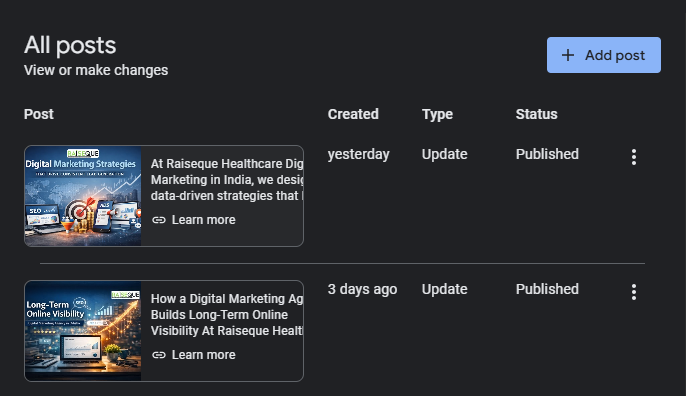
Just like social media, Google allows business posts—use them!
Post about:
- Health awareness days
- Clinic offers or new services
- Tips like “How to prevent seasonal flu”
It keeps your profile fresh and increases your chances of showing up in search.
6. Use Relevant Keywords for Local SEO
Use keywords patients actually search for:
- “Orthopedic clinic in Chandigarh”
- “Best ENT specialist near me”
- “24/7 emergency doctor [City]”
Include them naturally in:
- Business description
- Posts
- Service list
- Website linked to your GBP
7. Build Local Citations
List your clinic consistently across trusted healthcare platforms:
- Practo
- Lybrate
- JustDial
- Sulekha
- Local directories and healthcare forums
Make sure your Name, Address, and Phone number (NAP) is exactly the same everywhere.
8. Track and Improve with Google Insights
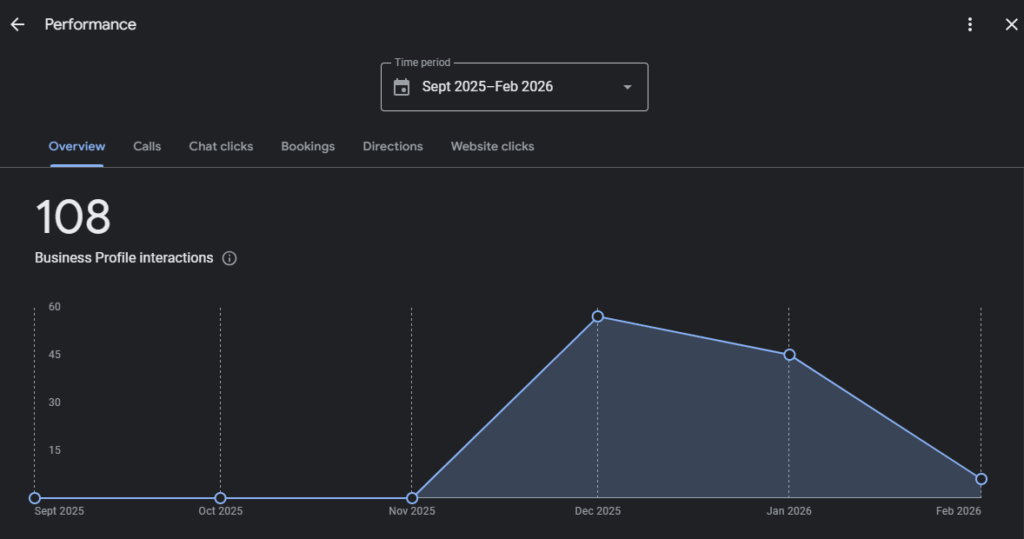
Google Business Profile gives you data like:
- How many people saw your profile
- Clicked your website
- Asked for directions
Use these insights to refine your strategy. For example, post more on days with high traffic or promote under-clicked services.
Common Google Business Profile Mistakes in Healthcare
- Using keywords in business name
- Duplicate clinic listings
- Incorrect location pin
- Ignoring negative reviews
- Outdated operating hours
These mistakes can suppress Google Maps visibility.
How Google Uses GBP Data for Healthcare Rankings
Google evaluates:
- Relevance – match to search intent
- Distance – proximity to the user
- Prominence – reviews, engagement, authority
Well-optimized healthcare profiles consistently outperform competitors.
FAQs
Q1. How do I optimize my Google My Business profile?
Start by claiming your listing, completing all profile sections with accurate information, adding photos, collecting reviews, and posting updates regularly.
Q2. How do I get my Google Business Profile to rank higher?
Use keywords, encourage patient reviews, maintain NAP consistency, and update your profile regularly. Engagement is key.
Q3. How to increase SEO for Google Business Profile?
Incorporate location-based keywords, publish posts, and ensure consistent listings on external directories. Optimize your photos and get more user interactions.
Q4. How do I make my Google Business Profile stand out?
Add high-quality photos, a welcoming business description, regular posts, and detailed service lists. Respond quickly to reviews and questions from potential patients.
Final Thoughts
Your Google Business Profile is your digital front door. With the right optimization, it can be your clinic’s most powerful patient magnet.
Whether you’re a solo doctor or part of a multi-specialty clinic, these strategies will help you show up higher in searches, connect with local patients, and grow your medical practice faster.
Are you struggling to attract new patients or promote your clinic, hospital, or healthcare services effectively?
In today’s competitive and fast-paced digital world, simply being a good doctor or running a quality healthcare facility isn’t enough. You need a clear, strategic approach to reach your audience—and that’s where understanding the 4 Ps of Healthcare Marketing and the 5 P’s of healthcare marketing becomes essential.
This blog serves as a complete, easy-to-understand guide for doctors, clinic owners, hospital marketers, and healthcare professionals who want to grow their business the smart way. We break down the traditional 4 Ps—Product, Price, Place, and Promotion—and show how they apply directly to medical practices. Then, we explore the powerful fifth ‘P’: People, which is all about trust, patient relationships, and experience.
You’ll learn how to implement these principles in real life, build brand awareness, increase patient footfall, and differentiate your practice in a crowded market. Whether you’re just starting or looking to scale, this guide gives you actionable marketing strategies that work in the healthcare space.
Read: The 7Ps of Marketing Mix
In today’s competitive world, healthcare providers need more than just medical expertise to attract and retain patients. Whether you’re a doctor, clinic owner, hospital marketer, or healthcare entrepreneur—effective marketing is no longer optional, it’s essential.
One of the most powerful frameworks to grow your healthcare business is understanding the 5 Ps and 4 Ps of Healthcare Marketing.
These marketing principles help you:
- Attract more patients
- Build trust in your brand
- Improve patient experience
- Grow sustainably (online & offline)
Let’s break them down in simple, easy-to-understand terms 👇
✅ What Are the 4 Ps of Healthcare Marketing?

What are the 4Ps of Healthcare Marketing?: The 4Ps of healthcare marketing are a framework used by clinics and hospitals to attract and retain patients.They include:
– Product (medical services and treatments)
– Price (consultation and treatment cost)
– Place (clinic location and online presence)
– Promotion (marketing and advertising strategies)
| 4P | Healthcare Example |
| Product | Dental treatment |
| Price | ₹500 consultation |
| Place | Clinic location + GMB |
| Promotion | Google Ads |
If you’re a doctor, clinic owner, or part of a healthcare marketing team, you’ve probably asked yourself:
“How do I promote my healthcare services effectively without sounding too salesy?”
The answer lies in a powerful, time-tested framework called the 5 P’s of Healthcare Marketing.
These 5 P’s—Product, Price, Place, Promotion, and People—help you build trust, attract more patients, and grow your practice or hospital sustainably.
Let’s break them down in simple language 👇
The 4 Ps of Healthcare marketing—originally from traditional business models—are perfectly suited for the healthcare sector when applied correctly.
1. Product – Your Healthcare Services
Your product is not a physical item, but your healthcare service. This includes:
- Medical consultations
- Surgeries or diagnostic services
- Therapy and wellness programs
- Patient experience and outcomes
A great product in healthcare means quality care, trust, and results.
Product means the service you provide to patients.
2. Price – What Your Patients Pay
Price in healthcare includes:
- Consultation charges
- Packages (e.g., full-body checkups)
- Insurance or co-payment structures
Patients want both value and transparency. Make your pricing clear, competitive, and backed by quality.
3. Place – How & Where You Deliver Care
This includes:
- Hospital or clinic location
- Online consultations (telemedicine)
- Home care or sample collection services
Patients value convenience, so make your services accessible both offline and online.
4. Promotion – How You Reach Patients
Promotion is how you tell people about your services. Examples include:
- Digital marketing (Google, YouTube, Instagram, SEO)
- Print ads or health camps
- Word-of-mouth or referral programs
But the golden rule in healthcare is: educate, don’t just sell.
🔁 5Ps of Marketing in Healthcare Industry (With Examples)

Modern healthcare marketing adds a 5th “P” to the traditional model: People.
This makes the 5 P’s framework even more powerful.
Let’s explore all five in a complete, real-world way:
🩺 1. Product – Your Service + Patient Experience
Your product is everything the patient experiences from first contact to recovery.
It includes:
- Type of treatment or specialty
- Modern facilities or technology
- Follow-up care and communication
- Trust and clinical excellence
✅ Tip:
Highlight what makes your service unique—like emergency care, women-only clinics, or specialized treatments.
💸 2. Price – Affordability & Transparency
Whether it’s a ₹300 consultation or a ₹1,00,000 surgery, pricing must be fair, clear, and justified.
Include:
- Fee breakdowns
- Health packages
- Insurance support or payment plans
✅ Tip:
Offer easy-to-understand rates online. Patients feel safer when pricing is upfront.
📍 3. Place – Accessibility Matters
Where and how your service is delivered is critical. Today, healthcare is hybrid—in-person + online.
Channels may include:
- Clinics and hospitals
- Mobile health vans
- Video consultations
- At-home diagnostic tests
✅ Tip:
Add Google Maps to your website, enable WhatsApp or app-based bookings, and keep your location info up-to-date.
📢 4. Promotion – Let People Know You Exist
You could be the best doctor, but if people don’t know you exist—you won’t grow.
Promotional methods:
- Google Ads and SEO
- YouTube health tips
- Instagram Reels and doctor reels
- Blogging and newsletters
- Reviews and testimonials
✅ Tip:
Build credibility through education, patient stories, and useful tips. Trust wins over selling.
👨⚕️ 5. People – The Humans Behind the Brand
Patients remember how they were treated more than what they were treated for.
People includes:
- Doctors and specialists
- Nurses and receptionists
- Customer support staff
- Social media teams
Everyone in your team is a brand ambassador for your clinic or hospital.
✅ Tip:
Train your staff on soft skills. Empathy, smile, and patience go a long way.
🔍 Why These P’s Matter in Healthcare Marketing
In healthcare, marketing isn’t just about increasing revenue. It’s about reaching the right patients, at the right time, with the right message.
Here’s what the 4 Ps and 5 Ps help you do:
✅ Build brand trust and visibility
✅ Increase patient footfall and bookings
✅ Improve patient satisfaction
✅ Stand out from competitors
✅ Future-proof your practice with digital tools
✍️ Final Thoughts
Healthcare is deeply personal. People don’t buy services—they seek care, trust, and confidence. The 5 Ps and 4 Ps of healthcare marketing help you connect with your audience in the right way.
Whether you’re a solo practitioner or managing a large hospital—these principles work when applied with honesty and consistency.
FAQ(Frequently Asked Questions)
Q: What are the 4 Ps of healthcare marketing?
The 4Ps of healthcare marketing are a framework used by clinics and hospitals to attract and retain patients. They include:
Product: Medical services and treatments offered
Price: Consultation and treatment cost
Place: Clinic location and online visibility
Promotion: Marketing strategies like SEO, ads, and social media
These four elements help healthcare businesses improve visibility, build trust, and increase patient flow.
Q: What is the difference between 4 Ps and 5 Ps in healthcare marketing?
The 5 Ps include all elements of the 4 Ps (Product, Price, Place, Promotion) plus People. In healthcare, “People” is critical because patient experience, doctors, and staff directly impact trust and satisfaction.
Q: Why are the 4 Ps important in healthcare marketing?
A: The 4 Ps help healthcare providers:
Attract the right patients
Improve service positioning
Optimize pricing strategies
Build strong brand awareness
This leads to consistent patient growth and better ROI.
Q: How can clinics use the 4 Ps to get more patients?
Clinics can apply the 4 Ps by:
Offering specialized treatments (Product)
Setting competitive consultation fees (Price)
Improving online and offline accessibility (Place)
Running ads and SEO campaigns (Promotion)
Q: How long does it take for healthcare marketing to show results?
SEO: 30–90 days
Paid Ads: Immediate results
Content Marketing: 60–120 days
Consistency is key for long-term growth.
How do the 4Ps help clinics get patients?
The 4Ps help clinics get patients by optimizing every stage of the patient journey:
Place ensures your clinic appears in searches like “clinic near me”
Promotion drives traffic through SEO, ads, and social media
Product matches patient needs with the right treatment
Price builds trust and influences decision-making
When combined, the 4Ps create a system that attracts, converts, and retains patients consistently.
What is the difference between 4Ps and 7Ps?
The 4Ps focus on core marketing elements:
Product, Price, Place, Promotion
The 7Ps expand this framework by adding:
People (staff and patient interaction)
Process (appointment and treatment journey)
Physical Evidence (reviews, infrastructure, trust signals)
In healthcare, the 7Ps are more effective because they include patient experience and trust, which are critical for decision-making.
At Raiseque, we help doctors, clinics, and hospitals grow through ethical, education-based digital marketing.
We don’t just run ads—we build trust.
👉 Let’s talk.
📞 Book a free consultation with our healthcare marketing experts.
What is Digital marketing in healthcare? Healthcare digital marketing is the strategy and tactics healthcare organizations use to effectively and efficiently reach their consumers, patients, and members through digital channels. Such as websites, social media, search engines, email, and paid advertising—to promote medical services, engage with patients, and improve brand visibility. Unlike traditional marketing, which relies on print media and in-person outreach, digital marketing allows healthcare providers to reach a broader audience efficiently and cost-effectively. Through digital channels, hospitals, clinics, and individual practitioners can share useful health content, communicate in real time, and build strong relationships with both existing and potential patients. This approach not only boosts patient acquisition but also fosters long-term trust and brand loyalty.
What Is Healthcare Digital Marketing?
Healthcare digital marketing refers to the use of digital strategies and online platforms to promote healthcare services, engage patients, and build trust with target audiences. It empowers hospitals, clinics, and healthcare providers to establish a strong online presence, educate patients, and drive informed health decisions.
In the digital age, today’s healthcare consumers are more proactive than ever. Instead of relying solely on doctor visits, they turn to online resources for education and decision-making. Effective digital marketing helps healthcare organizations meet these expectations by delivering relevant, accessible, and trustworthy content.
Let’s take a look at some key statistics:
- 77% of people search for health information online during their patient journey.
- Health-related queries account for 5% of all daily Google searches—around 300,000 searches every minute.
- 59% of adults use the internet to find medical information, with women leading in online health research.
- 89% of college graduates and 70% of high school graduates research health issues online.
- 70% of patients report that online information influences their treatment decisions.
These numbers reflect a major shift in how patients approach healthcare. With easy access to the internet, they now research symptoms, check doctor reviews, compare healthcare providers, and engage in online health communities—all before booking an appointment.
1. Why Digital Marketing Matters in Healthcare

Digital marketing plays a critical role in transforming how healthcare providers connect with patients, build trust, and deliver value in today’s digital-first world. With the majority of patients turning to online platforms to research symptoms, find nearby clinics, or read doctor reviews, having a strong digital presence is no longer optional—it’s essential.
From improving visibility on search engines to enabling real-time communication through social media, digital marketing empowers healthcare brands to engage with patients at every stage of their journey. It also offers data-driven insights that help optimize campaigns, personalize care, and enhance patient experience.
Moreover, digital marketing is cost-effective, measurable, and scalable—allowing even small clinics or solo practitioners to compete with larger healthcare organizations. Whether it’s through SEO, email campaigns, or paid ads, these strategies help increase patient acquisition, improve retention, and boost overall practice growth.
In short, digital marketing bridges the gap between healthcare providers and modern patients—delivering the right message, to the right person, at the right time, while building lasting trust and loyalty.
Increased Visibility Through Digital Channels
Healthcare providers must stand out in a competitive environment. Digital marketing helps them become more visible where patients search for services.
- Utilize SEO to rank for terms like “best cardiologist near me.”
- Run Google Ads and Meta Ads to reach specific patient groups.
- Optimize your Google Business Profile to show up in local searches.
A strong online presence leads to:
- Higher search engine rankings
- More website visits
- Increased appointment bookings
2. Key Benefits Of Digital Marketing in Healthcare

Digital marketing offers a wide range of benefits for healthcare providers. First, it helps increase online visibility, making it easier for patients to find services through search engines and social media. It also improves patient engagement by sharing valuable content such as health tips, blogs, videos, and FAQs.
Through tools like Google Ads and email marketing, providers can deliver personalized messages to targeted audiences, enhancing the effectiveness of campaigns. Digital marketing is cost-effective compared to traditional methods and offers real-time analytics, enabling constant optimization. Most importantly, it helps healthcare brands establish trust, improve the patient experience, and achieve long-term growth.
Engaging Patients with Valuable Content
Content marketing plays a major role in digital healthcare strategies. Educating patients builds trust and keeps them engaged.
- Publish blogs, FAQs, and how-to articles on common health topics.
- Share infographics, videos, and explainer reels on social media.
- Host live Q&A sessions on Facebook or Instagram to address concerns.
These content formats help:
- Reduce patient anxiety
- Empower patients with knowledge
- Build a lasting relationship between provider and patient
Precise Targeting and Personalization
Digital tools allow healthcare marketers to reach specific audience segments with tailored messages.
- Segment audiences by age, gender, location, medical condition, and online behavior.
- Use email automation to send personalized messages.
- Deliver ads to users who previously visited your website (retargeting).
This level of personalization:
- Increases campaign efficiency
- Improves patient satisfaction
- Reduces ad spend waste
Cost-Effective Strategies for Greater Reach
Compared to traditional methods like TV and print, digital marketing offers better value.
- Run hyper-local ad campaigns with a small budget.
- Use A/B testing to optimize ad performance.
- Monitor campaign results in real-time and adjust strategies accordingly.
Cost-effective digital channels include:
- Google Ads
- Facebook & Instagram Ads
- LinkedIn Ads for B2B healthcare services
Data-Driven Decisions and Measurable Results
One major advantage of digital marketing in healthcare is access to performance metrics.
Track:
- Website visits and bounce rates
- Conversion rates and appointment bookings
- Ad clicks, email open rates, and social engagement
These insights help:
- Refine your strategies
- Improve user experience
- Make informed marketing decisions
3. Key Digital Marketing Strategies in Healthcare

Healthcare organizations can implement several powerful digital marketing strategies to achieve their goals. Social media marketing allows providers to build communities and engage with patients through stories, tips, and live Q&A sessions. SEO helps optimize websites to rank higher in search engine results, attracting organic traffic.
Content marketing involves publishing helpful articles and videos that answer patient questions and build authority. Email marketing keeps patients informed and connected, while paid advertising offers immediate visibility and conversion. Local SEO ensures practices show up in local searches and maps, increasing foot traffic. Together, these strategies create a well-rounded, results-driven approach.
1. Social Media Marketing
- Build a community on platforms like Facebook, Instagram, and TikTok.
- Share behind-the-scenes content, patient stories, and live sessions.
- Create Facebook Groups for niche topics like diabetes care or prenatal support.
2. Search Engine Optimization (SEO)
- Use local keywords like “dentist in Miami” or “ENT near me.”
- Focus on:
- On-page SEO (content optimization, metadata)
- Off-page SEO (backlinks, local citations)
- Technical SEO (mobile-friendliness, page speed)
3. Content Marketing
- Create helpful content such as:
- “What to Expect During an MRI?”
- “Top 5 Foods to Boost Immunity”
- “Early Signs of Thyroid Disorders”
- Use quizzes, symptom checkers, and interactive guides to increase engagement.
4. Email Marketing
- Send appointment reminders and health tips.
- Use dynamic content and personalized subject lines.
- Segment lists to tailor messages to different patient types.
5. Paid Advertising
- Target high-intent keywords like “emergency clinic open now.”
- Run Google Search Ads, YouTube Ads, and Display Ads.
- Retarget previous website visitors with specific offers or reminders.
6. Local SEO
- Optimize Google Business Profile for every clinic location.
- Collect positive patient reviews.
- Add location-specific service pages and use local keywords.
4. Advantages of Digital Marketing in Healthcare

The long-term value of digital marketing in healthcare goes beyond just attracting patients. It strengthens brand recognition and builds credibility in the community. Consistent digital presence ensures that patients remember your services when they need them. It also improves patient retention by offering continued value through educational content, follow-up reminders, and personalized communication.
Digital tools like online booking, telehealth platforms, and chatbot support improve the overall patient experience. Furthermore, promoting in-network services helps patients make informed decisions and encourages them to stay within your healthcare system. In the long run, digital marketing drives sustainable growth and higher patient satisfaction.
- ✅ Patient Acquisition and Retention
- ✅ Better Brand Recognition and Trust
- ✅ Improved Patient Experience Through Digital Tools
- ✅ Higher Utilization of In-Network Services
One of the key trends shaping healthcare marketing is the integration of multiple digital channels to create a unified patient experience. Instead of relying on a single platform, clinics and hospitals are adopting a more structured approach to healthcare marketing that combines search visibility, paid campaigns, and content-driven engagement to attract and retain patients.
FAQ’s
What are the 4 P’s of Healthcare Marketing?
The 4 P’s Of Healthcare Marketing is
Product: Medical services and specialties offered
Price: Cost and payment options for services
Place: Where patients can access care (clinics, online, home)
Promotion: Advertising and outreach strategies
What is Digital Marketing in Healthcare?
Digital marketing in healthcare is the use of online tools like websites, emails, social media, and search engines to promote medical services, connect with patients, and build trust.
What are the 5 P’s of Healthcare Marketing?
The 5th P is People, which emphasizes the importance of patient relationships and healthcare staff in marketing success.
How is Digital Marketing Useful for Doctors?
Builds online visibility
Attracts new patients
Enhances reputation via reviews
Allows targeted communication
What is Digital Marketing in Healthcare PDF?
A PDF guide or report explaining digital strategies, tools, benefits, and case studies related to healthcare marketing.
What Are Some Real-World Examples of Digital Marketing in Healthcare?
A hospital promoting free health checkups via Facebook Ads
A pediatric clinic ranking #1 on Google for local keywords
A wellness brand sharing daily tips on Instagram Stories
Conclusion
Digital marketing in hospitals during this pandemic is a marketing strategy that has many benefits, including attracting new patients, expanding business, increasing customer/patient trust, strengthening customer/patient loyalty, increasing brand awareness, encouraging patients to use hospital services, and promoting the services to patients’ relatives and family.
The selection of methods or channels for digital marketing depends on the goals or targets to be achieved by the hospital. After determining the goals of digital marketing, the hospital determines the choice of methods or digital media channels that will be used, then determines the goals, targets, and objectives to be achieved from each of the selected media, analyzes the situation and audience/market share, and determines the budget and marketing frequency.
Furthermore, for its implementation, it is necessary to determine who will carry out the marketing strategy that has been chosen. Moreover, monitoring and evaluation of each digital marketing strategy that has been implemented must be carried out so that the hospital can achieve its goals or targets effectively and efficiently. As digital platforms continue to evolve, healthcare businesses must also stay updated with the latest digital marketing trends in India, including AI-powered marketing, local SEO, and patient engagement strategies, to remain competitive and improve long-term online growth.