
80%+ patients search online before choosing a hospital—if you’re not ranking, you’re invisible. SEO for hospitals improves online visibility, builds credibility, and connects hospitals with patients actively searching for treatment.
This guide explains how a structured healthcare SEO strategy helps hospitals rank higher and attract genuine patient inquiries.
This guide explains how a structured healthcare SEO strategy helps hospitals rank higher and attract genuine patient inquiries.
For expert implementation, partnering with a professional healthcare marketing team like Raiseque Healthcare Digital Marketing ensures your hospital achieves consistent growth and higher search visibility.
Hospital SEO is the process of optimizing a hospital’s website and online presence to rank higher on Google for patient-related searches like “hospital near me” or “best orthopedic doctor.” Understanding how do SEO services help hospitals is important because effective SEO improves online visibility, increases patient trust, and helps hospitals attract more local patient inquiries organically.
It includes local SEO, content optimization, Google Business Profile management, and patient review strategies.
What Is SEO for Hospitals?
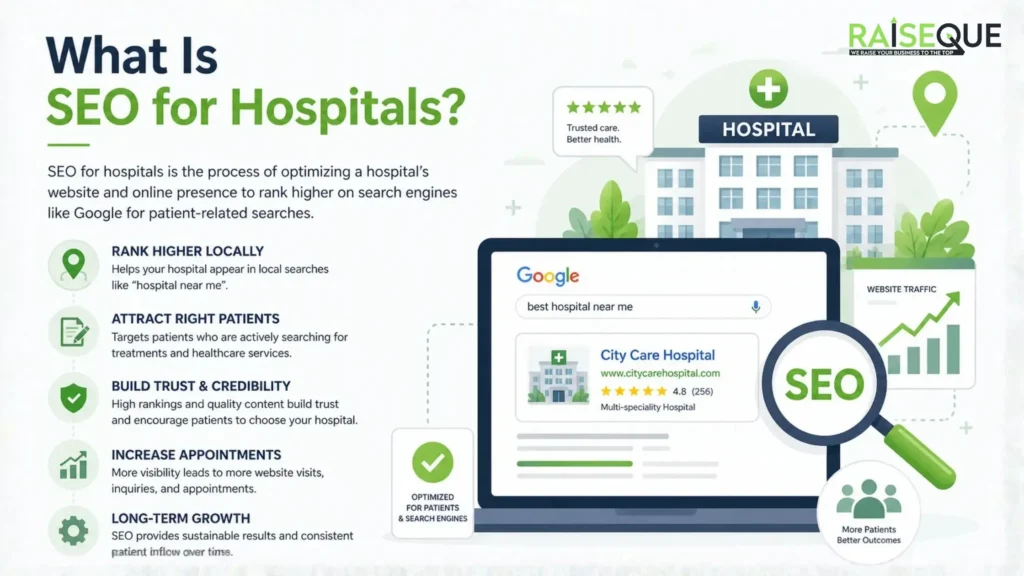
SEO for hospitals is a specialized digital marketing strategy that optimizes a healthcare facility’s website and online presence to rank higher in search results (like Google). It focuses on increasing visibility for patient queries—such as “best pediatrician near me”—to drive organic traffic, build trust, and boost appointment bookings.
Local SEO
Local SEO helps hospitals appear in location-based searches when patients look for nearby healthcare services. By optimizing Google Business Profile, maintaining consistent Name, Address, and Phone details, and using location-specific keywords, hospitals can improve their visibility in local results and maps. This ensures that patients in the surrounding area can easily find and contact the hospital when they need immediate or planned medical care.
Content Marketing
Content marketing focuses on creating valuable, patient-focused information that answers common healthcare questions. Hospitals can publish blogs, treatment guides, FAQs, and preventive care tips to educate patients and build trust. High-quality content improves search rankings and keeps users engaged. When content aligns with patient intent, it not only attracts traffic but also supports better decision-making and encourages patients to choose the hospital.
Technical SEO
Technical SEO ensures that a hospital website performs efficiently and provides a smooth user experience. This includes improving website speed, ensuring mobile responsiveness, fixing crawl errors, and maintaining a clean site structure. Proper technical optimization helps search engines understand and index the website effectively. A technically strong website not only ranks better but also keeps users engaged and reduces bounce rates.
E-E-A-T (Experience, Expertise, Authoritativeness, and Trustworthiness)
E-E-A-T is a critical factor in healthcare SEO, as patients rely on accurate and trustworthy information. Hospitals must demonstrate expertise by showcasing qualified doctors, verified medical content, and real patient experiences. Authoritativeness comes from strong online presence and mentions, while trustworthiness is built through transparency and credibility. Following E-E-A-T principles helps improve rankings and ensures patients feel confident in the hospital’s services.
Hospital SEO vs Clinic SEO: Key Differences
Many hospitals make the mistake of applying a clinic-level SEO strategy to a much more complex organisation. Understanding the differences is essential before building your strategy.
| Factor | Hospital SEO | Clinic SEO |
|---|---|---|
| Scope | Multiple departments, specialties, locations | Single specialty or service line |
| Pages needed | 100+ (each department, doctor, service) | 10–30 pages typically sufficient |
| Keyword strategy | Multi-specialty + local + emergency keywords | Single-specialty local keywords |
| Content complexity | Very high — requires medical accuracy across all departments | Moderate — focused on one area |
| Google Business Profile | Multiple GBP listings (one per location/department possible) | Single GBP listing |
| HIPAA complexity | High — multiple touchpoints and data systems | Moderate |
| Review management | Across multiple platforms and departments | Primarily Google and Practo/Healthgrades |
| Schema types needed | Hospital, Physician, MedicalClinic, FAQPage, LocalBusiness | MedicalClinic, Physician, LocalBusiness |
✅ Quick win: If you are using WordPress, plugins like RankMath or Yoast SEO Premium can generate most of this schema automatically. However, always verify implementation using Google’s Rich Results Test tool.
Why SEO Is Important for Hospitals ?
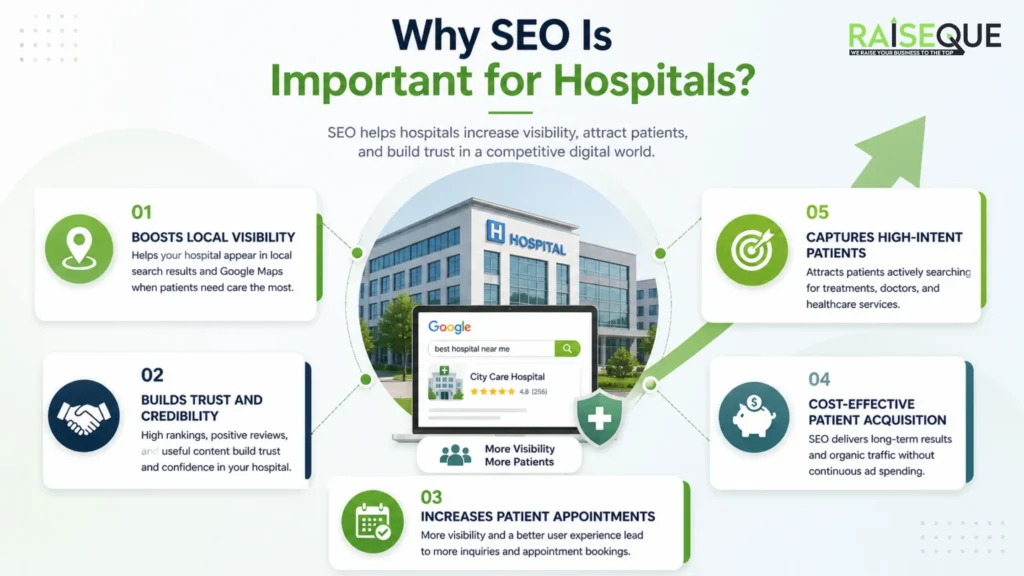
SEO is crucial for hospitals to increase visibility, attract patients, and build trust in a competitive, local digital market. As 77% of patients search online before booking, high search rankings drive patient acquisition, and Local SEO ensures clinics appear in relevant “near me” searches.
To achieve consistent results, hospitals must focus on the following core SEO components:
1. Boosts Local Visibility
SEO helps hospitals appear in local search results when patients look for nearby treatments or services. By optimizing location-based keywords, Google Business Profile, and consistent contact details, hospitals can rank higher in map listings and “near me” searches. This increases visibility among nearby patients actively seeking care. Professional Hospital SEO Services ensure accurate local optimization, helping hospitals attract more relevant traffic and improve their presence in competitive local markets.
2. Builds Trust and Credibility
Patients trust hospitals that appear at the top of search results with accurate and reliable information. SEO strengthens credibility by highlighting doctor expertise, certifications, and verified medical content. Positive patient reviews and informative blogs further build confidence. When hospitals consistently provide trustworthy content and maintain a strong online presence, patients feel more comfortable choosing their services.
3. Increases Patient Appointments
A well-optimized website guides patients smoothly from search to booking. SEO ensures that service pages, doctor profiles, and contact options are easy to find and use. Clear calls-to-action and mobile-friendly design encourage users to take action. This results in more appointment bookings and a steady flow of patient inquiries through the website.
4. Cost-Effective Patient Acquisition
SEO delivers long-term results without requiring continuous ad spending. Once a hospital achieves strong rankings, it can attract consistent organic traffic without paying for each click. This makes SEO a cost-effective strategy for acquiring new patients. Over time, it helps reduce marketing costs while maintaining steady growth in patient inquiries and online visibility.
5. Captures High-Intent Patients
SEO targets users who are actively searching for specific treatments, doctors, or healthcare services. These users have clear intent and are more likely to convert into patients. By optimizing content for relevant keywords and search queries, hospitals can attract highly qualified traffic that leads to better engagement, higher conversion rates, and improved patient acquisition outcomes.
6. Strengthens Competitive Advantage
Hospitals in competitive locations need strong online visibility to stand out. SEO improves rankings, enhances content quality, and delivers a better user experience. This helps hospitals outperform competitors and attract more patients. experience, consistent optimization produces sustainable growth compared to short-term advertising.
How to Do SEO for Hospitals
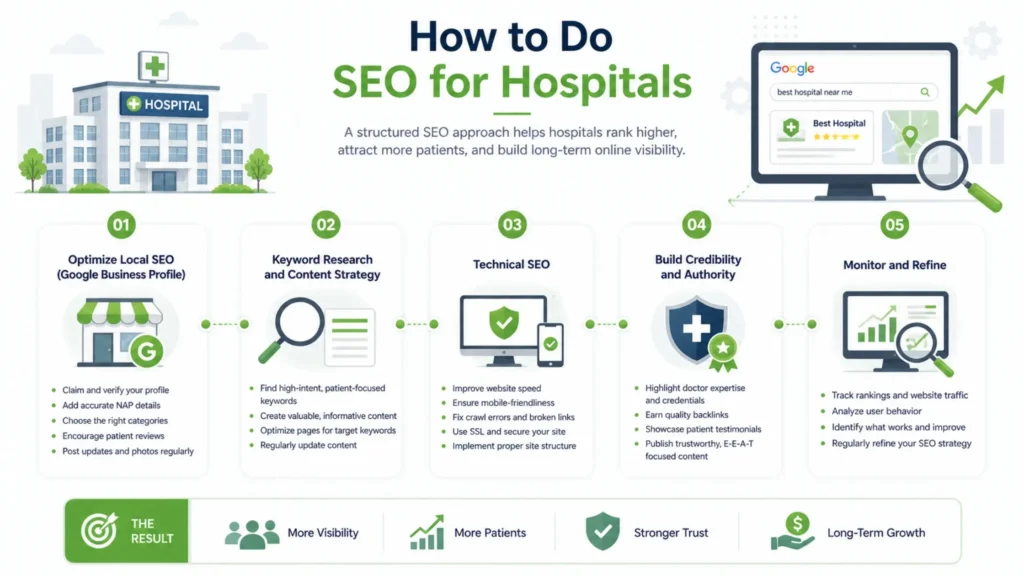
SEO for hospitals requires a strong focus on local visibility, patient trust, and technical accuracy. Key strategies include optimizing Google Business Profiles, targeting local keywords (e.g., “orthopedist near me”), creating authoritative, expert-verified health content, ensuring mobile responsiveness, managing patient reviews, and implementing schema markup.
The following strategies will help hospitals improve search visibility, build credibility, and consistently attract qualified patients.
1. Optimize Local SEO (Google Business Profile)
Local search visibility is essential for patient acquisition. Start by claiming and verifying your Google Business Profile to appear in Google Maps and local results. Ensure your Name, Address, and Phone number (NAP) remain consistent across all platforms. Add accurate operating hours, services, and high-quality images.
Select the most relevant categories such as “Multispecialty Hospital” and include attributes like “24/7 emergency.” Encourage patients to leave reviews and respond professionally to build trust. This directly strengthens local SEO for clinics and improves local rankings.
2. Keyword Research and Content Strategy
You should focus on patient-centric keywords based on real search behavior. Use terms like “hip replacement,” “MRI scan,” and location-based queries. This approach improves visibility and supports SEO for doctors by helping individual practitioners rank.
Create dedicated service pages for each treatment, highlighting advanced technology and experienced doctors. Build authority by publishing educational blogs that address patient concerns. Ensure medical professionals review content to meet E-E-A-T standards. Adding video content such as doctor introductions and patient testimonials enhances engagement and supports modern healthcare marketing strategies.
3. Technical SEO
A strong technical foundation ensures better rankings and user experience. Use a mobile-first design so your website works smoothly on all devices. Improve site speed, fix crawl errors, and maintain a clean navigation structure.
Implement schema markup to help search engines understand your hospital’s services, location, and appointment options.
4. Build Credibility and Authority
List your hospital consistently across trusted healthcare directories. Earn backlinks from reputable local and medical websites to improve domain authority and trust signals.
5. Monitor and Refine
Track performance using tools like Google Analytics and Search Console. Monitor keyword rankings, traffic, and user behavior. Analyze competitor strategies to refine your SEO approach continuously.
Hospitals can also combine organic efforts with Google Ads for hospitals to maximize visibility and attract patients at every stage of their search journey.
HIPAA-Compliant SEO Practices for Hospitals
HIPAA Compliance (Health Insurance Portability and Accountability Act) is not just a legal requirement in the US — it is an increasing standard globally, and it directly intersects with hospital SEO in ways that many marketing teams overlook.
Where HIPAA Compliance Affects SEO
- Review responses: Never confirm, deny, or include any patient-identifying detail in a public review response. A response that says “We’re glad your knee surgery went well, Mr. Sharma” is a HIPAA violation.
- Contact forms: Patient inquiry forms must use HTTPS and compliant data handling. An unsecured form on an HTTP page will also hurt your SEO.
- Analytics tracking: Standard Google Analytics 4 may collect PHI (Protected Health Information) through URL parameters (e.g. booking confirmation pages). Use GA4 with IP anonymisation and avoid tracking sensitive URL strings.
- Retargeting pixels: Meta Pixel and Google Ads remarketing tags should not fire on pages where health conditions or treatment intent can be inferred.
- Testimonials: Patient testimonials on your website require explicit written consent. Unconsented testimonials can result in regulatory action — and authentic, consented testimonials are stronger E-E-A-T signals anyway.
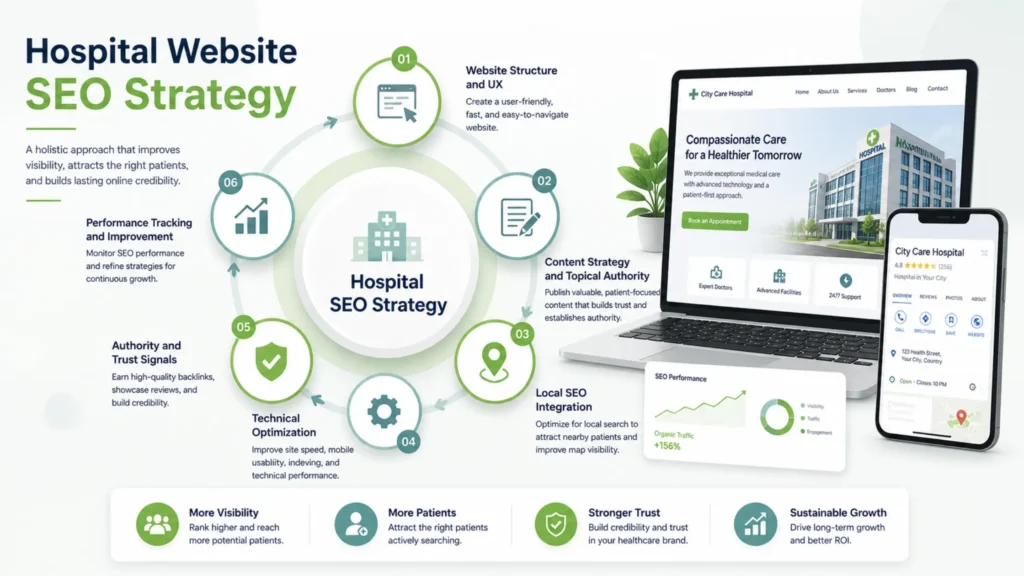
Hospital Website SEO Strategy
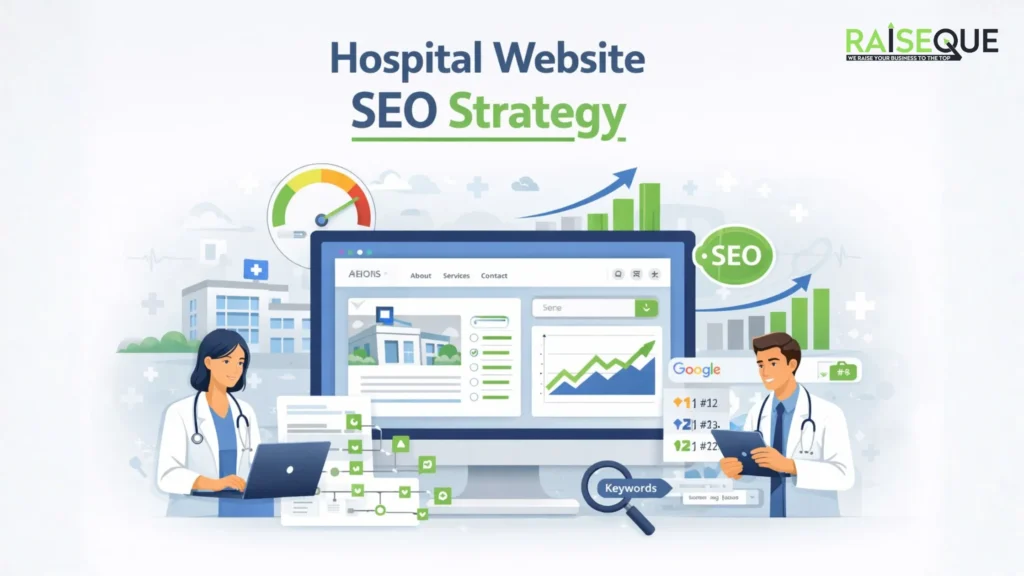
A successful hospital SEO strategy focuses on local search visibility, technical performance, and patient-focused content, while ensuring HIPAA compliance. Effective hospital SEO includes optimizing Google Business Profiles, using long-tail keywords (e.g., “knee surgery in Pune”), improving mobile load speed, and building trust through patient reviews and credible healthcare content.
The following key strategies help hospitals build a high-performing, search-optimized website:
1. Website Structure and User Experience
Hospitals should organize their website into clear sections such as services, doctor profiles, departments, and contact pages. A clean structure helps users navigate easily and allows search engines to understand content better. Use internal linking to connect related pages and improve engagement.
2. Content Strategy and Topical Authority
Content should focus on patient needs and search intent. Create topic clusters around treatments, conditions, and preventive care. Each service page should provide detailed, easy-to-understand information. Regular blog updates help build authority and align with effective healthcare marketing strategies.
3. Local SEO Integration
Hospitals must optimize their website for local searches by including location-based keywords naturally within content. Add consistent NAP details and embed maps to strengthen local SEO for clinics and improve local rankings.
4. Technical Optimization
Ensure the website is mobile-friendly, fast-loading, and secure. Fix broken links, improve site speed, and maintain a clear URL structure. Implement schema markup to enhance search engine understanding.
5. Authority and Trust Signals
Showcase doctor credentials, certifications, and patient testimonials to build trust. This improves credibility and supports both hospital branding and SEO for doctors.
6. Performance Tracking and Improvement
Monitor website performance using analytics tools. Track keyword rankings, user behavior, and conversions. Continuously refine your strategy based on data insights.
How Hospitals Rank on Google
Hospitals rank on Google by prioritizing local SEO, mainly through a fully optimized Google Business Profile (GBP), high-quality patient reviews, and mobile-friendly, authoritative website content. Key strategies include maintaining consistent NAP (Name, Address, Phone) data, using local keywords, and building backlinks, typically yielding results in 3-6 months.
The following factors play a key role in how hospitals rank on Google:
1. Content Relevance and Quality
Google evaluates how well your content matches patient search intent. Hospitals should create detailed, accurate, and easy-to-understand content for treatments, conditions, and services. Regularly updating blogs and service pages improves relevance and supports effective healthcare marketing strategies.
2. E-E-A-T and Trust Signals
Experience, Expertise, Authoritativeness, and Trustworthiness are critical ranking factors in healthcare. Hospitals that understand how to improve hospital search engine rankings SEO for hospitals should highlight doctor credentials, certifications, and verified medical content. This also improves visibility for individual practitioners through SEO for doctors.
3. Local Ranking Factors
Google uses proximity, relevance, and prominence to rank hospitals in local searches. Optimizing Google Business Profile, maintaining consistent NAP details, and collecting patient reviews significantly improve local SEO for clinics.
4. Technical SEO and User Experience
A fast, mobile-friendly, and secure website improves user engagement and rankings. Clear navigation, proper site structure, and schema markup help search engines understand your content better.
5. Backlinks and Online Authority
Google considers backlinks as a signal of trust. Hospitals should earn links from reputable healthcare websites, directories, and local organizations to build authority.
6. User Engagement Signals
Metrics like click-through rate, time on page, and bounce rate indicate content quality. A well-optimized website keeps users engaged and improves rankings over time.
Common SEO Mistakes Hospitals Should Avoid
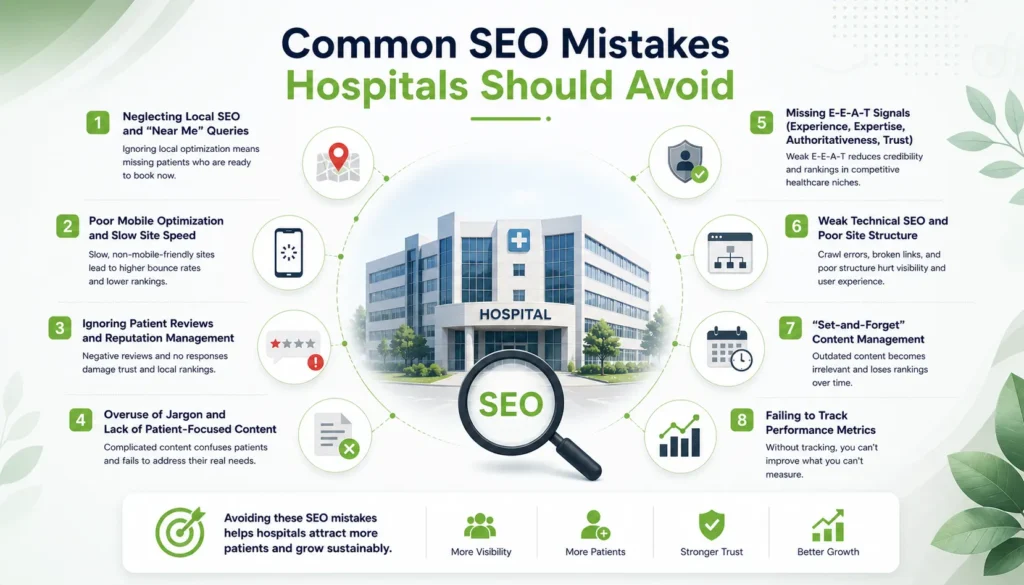
Hospitals often face unique SEO challenges due to strict compliance requirements (HIPAA), the need for local visibility, and the necessity of building trust (E-E-A-T: Experience, Expertise, Authoritativeness, and Trustworthiness).
Here are the most common SEO mistakes hospitals should avoid to maintain a strong online presence and attract patients:
1. Neglecting Local SEO and “Near Me” Queries
Patients search for nearby healthcare services, so local optimization is essential.
• Mistake: Not optimizing or updating Google Business Profile and inconsistent NAP details.
• Fix: Maintain accurate business information across all platforms and use location-based keywords to improve local visibility.
2. Poor Mobile Optimization and Slow Site Speed
Most patients search on mobile devices, especially in urgent situations.
• Mistake: Non-responsive design and slow-loading pages.
• Fix: Use mobile-friendly design, optimize images, and improve site speed for better user experience and rankings.
3. Ignoring Patient Reviews and Reputation Management
Patient reviews influence trust and local rankings.
• Mistake: Ignoring feedback or not encouraging reviews.
• Fix: Respond to all reviews professionally and actively collect patient feedback to build credibility.
4. Overuse of Jargon and Lack of Patient-Focused Content
Patients prefer simple and clear medical information.
• Mistake: Using complex medical terms or keyword stuffing.
• Fix: Create easy-to-understand, patient-focused content that answers real search queries.
5. Missing E-E-A-T Signals (Experience, Expertise, Authoritativeness, Trust)
Trust is critical for healthcare websites.
• Mistake: Publishing unverified or anonymous content.
• Fix: Add doctor credentials, author bios, and medically reviewed content to build authority and trust.
6. Weak Technical SEO and Poor Site Structure
A poorly structured website affects both users and search engines.
• Mistake: Confusing navigation and missing schema markup.
• Fix: Improve site structure and implement schema for better visibility in search results.
7. “Set-and-Forget” Content Management
SEO requires regular updates to stay relevant.
• Mistake: Outdated information and inactive blog sections.
• Fix: Update content regularly to maintain accuracy and improve rankings.
8. Failing to Track Performance Metrics
Tracking performance is essential for growth.
• Mistake: Not using analytics tools effectively.
• Fix: Monitor conversions, user behavior, and rankings to optimize your SEO strategy.
Conclusion
SEO for hospitals doesn’t work through keywords alone. Hospitals that rank higher on Google focus on trust, authority, local SEO, and patient experience together. That’s why many healthcare brands work with the best SEO specialists for hospitals to improve visibility and generate consistent patient inquiries.
At Raiseque, we’ve seen that hospitals with structured SEO systems achieve stronger long-term growth and sustainable rankings.
📩 Want a free SEO audit for your hospital website?
Comment “SEO” or message us directly.
SEO for Hospital Frequently Asked Questions
1. What is SEO for hospitals?
SEO for hospitals is the process of optimizing a hospital’s website and online presence to improve visibility on search engines like Google. It involves keyword optimization, content creation, local SEO, technical improvements, and reputation management. The goal is to help patients easily find relevant healthcare services when they search online. A well-executed SEO strategy increases website traffic, builds trust, and drives more patient inquiries by aligning content with patient needs and search intent.
2. Why is local SEO important in healthcare?
Local SEO is important in healthcare because most patients search for nearby hospitals, clinics, or doctors using location-based queries like “near me.” Optimizing for local SEO ensures that healthcare providers appear in Google Maps and local search results. It includes managing Google Business Profile, maintaining consistent contact details, and collecting patient reviews. Strong local SEO helps hospitals attract nearby patients, improve visibility in their service area, and increase appointment bookings from high-intent searches.
3. Is SEO better than paid ads for hospitals?
SEO and paid ads serve different purposes, but SEO offers long-term benefits for hospitals. SEO builds organic visibility, trust, and consistent traffic without ongoing costs per click. Paid ads provide immediate visibility and quick results but require continuous investment. A balanced strategy works best, where SEO drives sustainable growth while paid ads generate instant leads. Over time, SEO becomes more cost-effective and helps hospitals maintain a strong online presence even without active ad spending.
4. How do hospitals rank higher in google local search results?
Hospitals can rank higher in Google local search results by optimizing their Google Business Profile, using local SEO keywords, collecting positive patient reviews, maintaining accurate contact information, and publishing trusted healthcare content regularly. A fast, mobile-friendly website also improves local visibility.
5. What are the 4 P’s in healthcare?
The 4 P’s in healthcare refer to Product, Price, Place, and Promotion. Product includes the medical services offered, such as treatments and specialties. Price relates to the cost of services and transparency in billing. Place focuses on accessibility, including hospital location and online presence. Promotion involves marketing strategies like SEO, social media, and advertising. Together, these elements help hospitals attract patients, deliver value, and build a strong, competitive healthcare brand.
6. How long does SEO take for a hospital?
Hospital SEO typically takes 3–6 months to show noticeable improvements and 6–12 months for strong long-term rankings. The timeline depends on competition, website quality, content strategy, local SEO, and backlink strength. Consistent optimization helps hospitals attract more patients organically over time.
7. What is the cost of hospital SEO?
Hospital SEO costs vary based on the hospital size, competition, and services required. Small clinics may spend a few hundred dollars monthly, while large hospitals often invest thousands in advanced SEO, content marketing, and local optimization. The right strategy focuses on long-term patient acquisition and ROI.