Let’s Talk About What Actually Drives Growth
This guide breaks down the 7Ps of marketing mix in a simple, practical way. Instead of theory, you’ll understand how each element actually works in real business situations.
Understanding The 7Ps of Marketing can transform your approach to growth.
If you’ve been running a business for a while, you’ve probably noticed something:
You can run ads.
You can post on social media.
You can even rank on Google.
But still… growth feels inconsistent.
Some months are great.
Some months are slow.
What you need to know about The 7Ps of Marketing is that implementation requires careful consideration of each aspect.
Incorporating The 7Ps of Marketing into your strategy will enhance your overall effectiveness.
And you keep thinking:
“What am I missing?”
Here’s the answer — and it’s not another “hack” or tool.
You’re missing a system.
The framework of The 7Ps of Marketing includes various key components that drive business success.
That system is the 7Ps of Marketing Mix.
This isn’t theory. This is the framework behind:
- Successful brands
- Scalable agencies
- High-converting businesses
Once you understand it properly, everything in the definition of marketing starts making sense.
Marketing today is not just about running ads or posting on social media. If that worked consistently, every business would be growing fast. But that’s not the case.
Some businesses grow steadily, while others struggle even after spending money on marketing. The difference is not effort—it’s structure.
This is where the 7Ps of marketing mix come in. Think of it as a complete system that guides how your business attracts, converts, and retains customers.
In this blog, instead of confusing theory, we’ll break it down in a way that actually makes sense and is easy to apply.
What is The 7Ps of Marketing Mix?
Let’s explore the significance of The 7Ps of Marketing in today’s competitive landscape.
Here, you’ll understand how each “P” plays a role in shaping customer decisions and why combining all seven creates a complete and effective marketing approach.
By understanding The 7Ps of Marketing, businesses can develop stronger marketing strategies.
The 7Ps of Marketing guide marketers through essential decision-making processes.
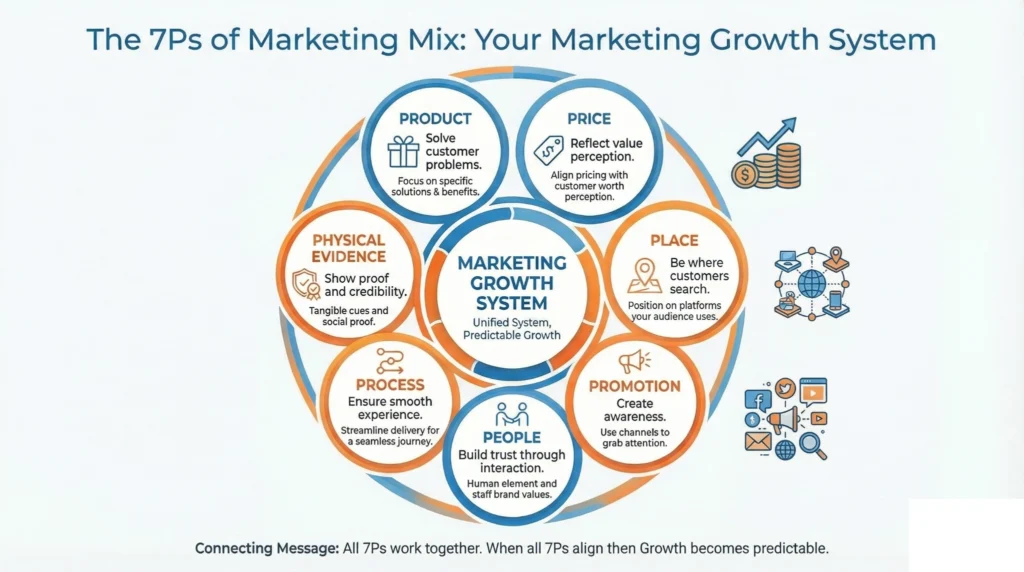
The 7Ps of Marketing Mix is a framework that helps businesses design and execute effective marketing strategies.
It includes:
Understanding how to implement The 7Ps of Marketing effectively can lead to significant advantages.
- Product
- Price
- Place
- Promotion
- People
- Process
- Physical Evidence
Think of it like this:
👉 These are the 7 decision areas that directly affect whether a customer:
- Notices you
- Trusts you
- Buys from you
- Comes back again
While many strategies exist, none are as comprehensive as The 7Ps of Marketing.
The 7Ps of marketing mix is a framework that helps businesses understand what influences customer decisions, based on the marketing mix concept explained Instead of focusing only on promotion or advertising, it looks at the entire system behind how a business operates and presents itself.
These seven elements—Product, Price, Place, Promotion, People, Process, and Physical Evidence—work together to shape how customers perceive your brand. When all seven are aligned, marketing becomes more effective and predictable. When even one is weak, it affects the overall results. This is why businesses that understand the 7Ps don’t just market better—they build stronger, more sustainable growth.
Why The 7Ps Matter More in 2026 (Than Ever Before)
With increasing competition and digital transformation, businesses must focus on customer experience, trust, and consistency—areas where the 7Ps framework provides clarity.
Let’s be practical.
Today’s customer:
- Googles everything
- Reads reviews before buying
- Compares 5 options instantly
- Trusts experience over ads
So if your marketing only focuses on promotion, you’ll struggle.
Because now:
Marketing = Experience + Trust + System
That’s exactly what the 7Ps cover.
If you compare today’s market with even five years ago, the difference is huge. Customers are smarter, more informed, and have more options than ever before. Before buying anything, they check reviews, compare alternatives, and look for proof. This means marketing is no longer just about grabbing attention—it’s about building trust and delivering a smooth experience.
The 7Ps framework becomes important here because it doesn’t just focus on visibility. It focuses on the complete journey. In 2026, businesses that win are not the ones who shout the loudest, but the ones who deliver the best overall experience.
The Evolution: From 4Ps to 7Ps
This section highlights how marketing has evolved from product-focused strategies to experience-driven approaches, making the additional 3Ps essential.
Originally, marketing had only 4Ps:
- Product
- Price
- Place
- Promotion
That worked when businesses sold physical products only.
But now:
- Services dominate
- Digital experiences matter
- Customer journey is complex
So 3 more Ps were added:
Even when pressure mounts, The 7Ps of Marketing provide a framework for steady growth.
- People
- Process
- Physical Evidence
👉 These 3 are what separate average businesses from premium brands
Earlier, businesses relied on the 4Ps of marketing: Product, Price, Place, and Promotion. This worked well when most businesses were selling physical products and competition was limited. But as markets evolved, especially with the rise of service industries and digital platforms, customer expectations changed. People started valuing experience, convenience, and trust more than just the product itself.
That’s when three more elements—People, Process, and Physical Evidence—were added. These additions made the model more practical for modern businesses. Today, ignoring these three can seriously limit your growth, especially if you are in a service-based or digital business.
Let’s Break It Down — The 7Ps in Real Life
1. Product — The Core of Everything7
Let’s start with a simple truth:
👉 If your product is weak, marketing cannot fix it.
It can bring attention.
But it cannot create satisfaction.
When we talk about product, most people think about features or what they are selling. But in reality, a product is much more than that. It includes the entire experience a customer gets from using your service or buying your offering.
A strong product solves a real problem and delivers clear value. If your product is not aligned with customer needs, no amount of marketing can sustain long-term growth. This is why successful businesses focus deeply on understanding their audience and continuously improving their product to meet expectations.
What “Product” Actually Means
It’s not just what you sell.
It includes:
- Features
- Quality
- Design
- Results
- Customer experience
Real Example:
- A hospital is not selling treatment
→ It’s selling trust, safety, and recovery - A marketing agency is not selling SEO
→ It’s selling leads and business growth
Key Insight:
Customers don’t buy products.
They buy:
👉 Solutions to their problems
By embracing The 7Ps of Marketing, you align various elements of your business for success.
Questions You Should Ask:
- What problem am I solving?
- Why should someone choose me?
- What makes my offer different?
A product is not just a physical item or a service—it’s the outcome people expect. For example, when someone buys a fitness program, they are not buying exercises; they are buying results like weight loss or better health. Similarly, when someone hires a marketing agency, they are not buying services like SEO or ads—they are buying growth. Understanding this shift is important because it helps you position your offering correctly.
When you focus on outcomes instead of features, your marketing becomes clearer and more effective.
2. Price — More Than Just a Number
Pricing is one of the most misunderstood parts of marketing.
Most people think:
👉 “Lower price = more sales”
But reality is different.
Price = Perception
- High price → Premium brand
- Low price → Budget option
Example:
Two clinics:
- One charges ₹300
- Another charges ₹1500
Still, the ₹1500 one is fully booked.
Why?
👉 Trust + positioning + perceived value
Common Pricing Strategies:
- Premium pricing (high quality perception)
- Penetration pricing (low entry price)
- Subscription pricing (monthly recurring)
- Freemium model (free + paid upgrades)
Key Insight:
👉 People don’t buy the cheapest.
👉 They buy what feels worth it
Pricing is not just about affordability. It plays a major role in how customers perceive your brand. Many businesses try to compete by lowering prices, thinking it will attract more customers.
But this often leads to reduced margins and weaker brand positioning. Price should reflect the value you provide. When customers see your offering as valuable, they are willing to pay more.
This is why some brands charge premium prices and still have high demand. Pricing is not just a financial decision—it is a strategic one, and understanding pricing strategies in marketing can help you position your brand effectively.
3. Place — Visibility Decides Everything
Place is about where and how customers access your product or service. In today’s digital world, this goes far beyond physical locations.
It includes your website, search engine presence, social media platforms, and online marketplaces. If your business is not visible where your customers are searching, you are missing opportunities. Even a great product cannot succeed if it is not easily accessible.
That’s why understanding your customer’s behavior and choosing the right channels is critical.
You might have the best service.
But if people can’t find you…
👉 You don’t exist.
What “Place” Means Today:
Today, place is largely digital. Customers search on Google, browse social media, and rely on online reviews before making decisions
- Google search
- Website
- Social media
- Marketplaces
- Physical location
Real Example:
- A clinic must appear on “doctor near me” searches
- A business must rank on Google + Maps
Biggest Mistake:
Businesses build services…
But ignore visibility.
Key Insight:
👉 Marketing starts where customers search.
Visibility directly impacts growth. If customers cannot find you easily, they will choose competitors who are more accessible. Ensuring strong presence across relevant platforms is one of the most important steps in building a successful marketing strategy.
4. Promotion — Getting Attention the Right Way
Promotion is how you communicate your value to your audience. A strong digital marketing strategy helps you attract attention and generate consistent leads. It includes all the activities you use to attract attention and generate interest.
This can be through SEO, social media, advertising, or content marketing. However, promotion is only effective when it is supported by a strong foundation. If your product, pricing, or process is weak, promotion will not deliver the desired results. It will only bring traffic without conversions.
This is what most people think marketing is. But it’s only one piece.
Promotion Includes:
- SEO
- Social media
- Google Ads
- Content marketing
- Email campaigns
Reality Check:
Running ads without system = wasted budget.
Example:
If:
- Your website is weak
- No reviews
- No clear offer
Then even the best ads won’t convert.
Key Insight:
👉 Promotion amplifies what already exists.
If your base is strong → results scale
If your base is weak → money burns
Promotion amplifies what already exists. If your business is strong internally, promotion will accelerate growth. If not, it will expose weaknesses. That’s why it’s important to fix foundational issues before investing heavily in promotional activities.
5. People — The Human Factor
People play a crucial role in shaping customer experience. No matter how good your product or marketing is, the way your team interacts with customers can make or break your business. From the first point of contact to after-sales support, every interaction matters. Customers remember how they are treated more than what they are sold.
Let’s be honest.
Most businesses don’t lose customers because of product.
They lose them because of people.
People Includes:
- Staff
- Sales team
- Support team
- Founders
This includes everyone involved in your business—sales representatives, support staff, and even leadership. Each person contributes to the overall perception of your brand. Proper training, communication, and attitude are essential to ensure consistent and positive customer experiences.
Real Example:
- Slow response → lost lead
- Rude behavior → lost customer
- Poor communication → no trust
Important Truth:
👉 Customers remember experience more than price
Strong relationships build trust. When customers feel valued and respected, they are more likely to return and recommend your business. Investing in your team is one of the most effective ways to improve customer satisfaction and long-term growth.
6. Process — The Hidden Growth Lever
Process refers to the systems and steps involved in delivering your product or service. A smooth and efficient process makes it easy for customers to interact with your business. On the other hand, a complicated or slow process can drive them away. Customers prefer convenience, and businesses that provide it have a clear advantage.
Imagine this:
A customer wants to buy.
But:
- Website is confusing
- Booking takes time
- No follow-up
Ultimately, The 7Ps of Marketing serve as a cornerstone for sustainable growth.
What happens?
👉 They leave.
Process = Customer Journey
It includes:
- Discovery
- Inquiry
- Purchase
- Delivery
- Follow-up
Every stage—from discovery to purchase to follow-up—is part of the process. Mapping this journey helps identify gaps and improve efficiency. Automation tools and clear workflows can significantly enhance the customer experience.
In conclusion, mastering The 7Ps of Marketing can significantly impact your overall business strategy.
Example:
Good process:
- Click → Book → Confirm → Reminder → Service
Bad process:
- Click → Confusion → Exit
Key Insight:
👉 Smooth process = higher conversions
A well-structured process reduces friction and increases conversions. When customers can move through each step without confusion, they are more likely to complete the purchase and return in the future.
7. Physical Evidence — Trust Builder
Physical evidence provides proof of your credibility. Since services are intangible, customers look for tangible indicators before making decisions. This includes your website, reviews, testimonials, and even your physical environment.
Services are intangible.
So customers look for proof.
Physical Evidence Includes:
- Website
- Reviews
- Testimonials
- Office design
- Branding
Elements like branding, office design, and online presence all contribute to how customers perceive your business. Positive reviews and professional presentation build confidence.
Example:
- 5-star reviews → trust
- Clean clinic → confidence
- Professional branding → credibility
Key Insight:
👉 People don’t buy services
👉 They buy confidence in results
Trust is built through proof. When customers see evidence of quality and reliability, they feel more comfortable choosing your business over competitors.
How the 7Ps Work Together
Now this is where things become really important. Most people understand each “P” individually, but the real power of the 7Ps comes when they work together as a system. Think of it like this—if your promotion is strong but your product is weak, customers will come but won’t stay.
If your product is great but your process is confusing, people will drop before buying. Every “P” supports the other. Product creates value, price positions it, place ensures visibility, promotion attracts attention, people build relationships, process ensures smooth delivery, and physical evidence builds trust. When all seven are aligned, marketing becomes predictable instead of random. That’s when you start seeing consistent growth instead of ups and downs.
The 7Ps are not separate.
They are connected.
Example (Hospital):
| P7 | Example |
|---|---|
| Product | Specialized treatments |
| Price | Affordable packages |
| Place | Google + Maps |
| Promotion | SEO + Ads |
| People | Doctors + Staff |
| Process | Easy booking |
| Physical Evidence | Reviews + Clean space |
If even one fails → growth slows.
Case Study Thinking (Simple but Powerful)
Instead of just understanding theory, it helps to think in real scenarios. Imagine two businesses offering the same service. One focuses only on running ads, while the other works on improving product quality, customer experience, and trust before promoting itself.
The first business may get leads, but conversions will be low and inconsistent. The second business, however, will not only attract customers but also convert and retain them. This is the difference the 7Ps create. When you start analyzing businesses using this framework, you’ll notice patterns. Successful businesses don’t rely on one strength—they build a balanced system across all seven elements.
Let’s compare two businesses:
Business A:
- Runs ads
- Has average service
- No reviews
- Poor process
👉 Result: Low ROI
Business B:
- Strong product
- Premium pricing
- Good reviews
- Smooth process
- Then runs ads
👉 Result: High ROI + growth
Common Mistakes Businesses Make
One of the biggest mistakes businesses make is focusing only on promotion. They invest in ads, social media, or SEO but ignore other important factors like process, people, or trust signals. As a result, they get traffic but struggle with conversions.
Another common mistake is underestimating customer experience. Slow responses, complicated processes, or lack of reviews can drive potential customers away. Some businesses also price incorrectly, either too low or too high without proper positioning. These mistakes often lead to inconsistent growth. The solution is simple—look at your business as a system and fix weak areas before trying to scale.
- Only focusing on ads
- Ignoring customer experience
- Weak website/process
- No trust signals
- Poor communication
👉 This leads to inconsistent growth
How to Apply the 7Ps (Step-by-Step)
Understanding the 7Ps is one thing, but applying them is what actually drives results. The first step is to audit your current business. Look at each “P” and identify where you are strong and where you are weak. The second step is to fix the weak areas.
For example, improve your website, simplify your process, or build more trust through reviews. Only after strengthening your foundation should you focus on scaling promotion. This step-by-step approach ensures that your marketing efforts don’t go to waste. When your system is strong, every effort you put into marketing delivers better results and long-term growth becomes easier.
Step 1: Audit Your Business
Ask:
- Is my product strong?
- Is pricing aligned?
- Am I visible online?
- Are promotions effective?
- Is my team trained?
- Is my process smooth?
- Do I have trust signals?
Step 2: Fix Weak Areas First
Don’t scale if:
- Website is poor
- Reviews are missing
- Process is broken
Step 3: Scale Marketing
Now:
- Run ads
- Do SEO
- Build content
👉 Results will multiply
FAQs
What are the 7Ps of marketing?
The 7Ps of marketing are Product, Price, Place, Promotion, People, Process, and Physical Evidence. These seven elements form a complete framework that helps businesses plan and execute their marketing strategy effectively. Instead of focusing only on advertising or sales, the 7Ps cover everything that influences a customer’s decision—from what you offer to how you deliver it.
For example, your product must solve a real problem, your pricing should reflect value, and your process should make it easy for customers to buy. When all these elements work together, marketing becomes more structured and results become more consistent.
Why are the 7Ps important?
The 7Ps are important because they help businesses avoid a common mistake—focusing only on promotion while ignoring other critical areas. Many businesses invest heavily in ads or social media but fail to convert leads due to weak processes or lack of trust.
The 7Ps provide a complete system that ensures every part of your business supports growth. By improving each element, you create a better customer experience, stronger brand perception, and higher conversions. This framework also helps in identifying gaps and making better strategic decisions, which leads to more sustainable and predictable results over time.
What is the difference between 4Ps and 7Ps?
The main difference between the 4Ps and 7Ps is the addition of three new elements: People, Process, and Physical Evidence. The original 4Ps—Product, Price, Place, and Promotion—focus mainly on selling products. However, as businesses evolved, especially in service and digital industries, customer experience became more important.
The additional 3Ps address this gap. People focus on interactions, process ensures smooth delivery, and physical evidence builds trust. Together, the 7Ps provide a more complete and practical approach to marketing, especially in today’s competitive and experience-driven market.
Are 7Ps useful for digital marketing?
Yes, the 7Ps are highly useful for digital marketing. In fact, they are even more relevant today because online businesses rely heavily on customer experience and trust. For example, promotion may bring traffic through SEO or ads, but process ensures a smooth website experience, and physical evidence like reviews builds credibility.
People play a role through customer support, while pricing and product positioning affect conversions. Without aligning all these elements, digital marketing efforts may fail to deliver results. The 7Ps help create a balanced and effective strategy that improves both traffic and conversions.
Final Conclusion (Read Carefully)
Marketing is not about doing more. It’s about doing the right things together.
When your:
- Product solves real problems
- Price reflects value
- Place ensures visibility
- Promotion creates awareness
- People build relationships
- Process removes friction
- Physical evidence builds trust
👉 Growth becomes predictable.
If you look closely, marketing is not about doing more activities—it’s about doing the right things in the right way. The 7Ps of marketing mix give you a clear structure to understand what actually drives results. Instead of guessing or relying on random tactics, you can focus on improving each part of your system step by step.
When your product delivers value, your pricing reflects that value, your visibility is strong, and your customer experience is smooth, growth becomes much easier to achieve. The key is consistency. When all 7Ps are aligned, your marketing stops feeling unpredictable and starts delivering reliable, long-term results.